
The Secret Map Inside Your Teeth | 3/6/26
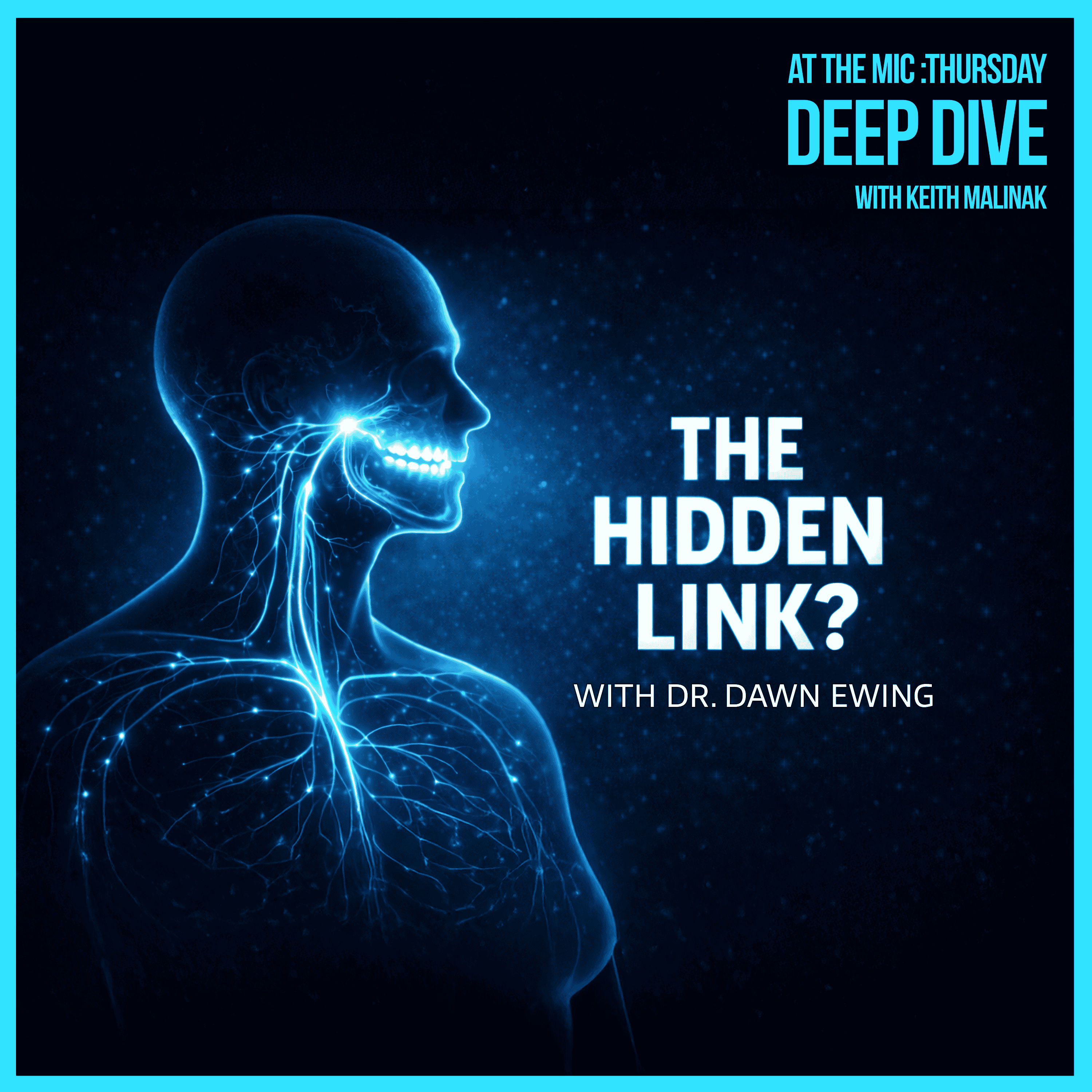






What if the mouth contained a hidden map of the body? Some researchers believe certain teeth may correspond with organs and nerve pathways in ways that challenge how we think about health.
In this Thursday Deep Dive, Keith Malinak sits down with Dr. Dawn Ewing to explore the controversial idea that the mouth may contain connections to the rest of the body through nerve pathways and meridian mapping. The conversation examines how oral health might influence systemic health, the theory behind dental meridians, and why some researchers believe infections or procedures in the mouth may affect organs and chronic conditions elsewhere in the body.
Along the way, Keith and Dr. Ewing discuss the history of these ideas, the documentary that helped bring attention to the topic, and the emerging field of biological dentistry. They also explore the role of dental materials, electrical pathways within the body, and how some practitioners investigate the possible links between oral health and overall well-being.
Whether you are hearing about dental meridians for the first time or are already curious about integrative health approaches, this conversation offers a thoughtful look at one of the more intriguing and debated connections in modern health discussions.
Guest
Dr. Dawn Ewing
Chapters:
- 00:00 The Hidden Map in Your Mouth
- 02:24 The Documentary That Started Questions
- 03:26 Why Dr. Dawn Began Investigating Dentistry
- 07:13 The Body’s Electrical Highway
- 14:13 When Dental Work Disrupts the System
- 22:00 The Root Canal Cancer Debate
- 30:28 Real Stories That Raised Alarms
- 40:42 Are Dental Materials Affecting Health?
- 50:26 What Is Biological Dentistry?
- 01:01:56 How to Start Investigating Your Own Health
- 01:21:36 Where to Learn More
KEITH MALINAK (00:01.23)
Hello, hello, hello. Welcome to this edition of At the Mic. I am your host, Keith Malinak, and as always grateful that you took the time to spend with us today. It's our weekly deep dive gathering since it is Thursday. That's what we do here. We got the wild card Wednesday, we got the Thursday deep dive, and then Friday we just hang out and cut up. I am looking forward to today's fascinating discussion on the deep dive program. Dr. Don Ewing will be here momentarily.
as a part of this episode, because what she has to say and the research that she has done, it could be life changing for you. So stick around here for that. First, I want to remind you to like, what are all the things? You got to rate, you got to review, you got to like, you got to subscribe. The One Person Project, just a reminder, please share the show with one person, whether it's this episode, it's the website, atmshow.com, the YouTube channel.
Wherever you are watching this or enjoying this, please do share it with one person. I'd be so grateful. And it would definitely help the program grow. Always want to thank Hero West for all that he does. look, I forget that I made. I'm just proud of this because now I don't have to hold up a piece of paper. On X, follow Wes at Second Floor Dallas. And also on X, follow Gabby at Jeffy Apologist.
They are behind the scenes. make everything go west obviously and with the thumbnails and the show descriptions and make sure it's a Spotify and Apple and YouTube rumble Gabby over there knocking out awesome content on Instagram and as always ATM show comm For all the links that you need. Okay Let's get to our conversation today. I've been looking forward to this one for sure Dr. Don Ewing was someone that I saw featured
in the documentary Root Cause. Root Cause. In fact, several of you have led me to that documentary in recent months, and I finally watched it. And it's a documentary that shows the connection between what happens in your mouth and your teeth and what happens to the rest of your body. It's a very health-focused documentary.
KEITH MALINAK (02:24.214)
and it talks to a lot of experts and Dawn was one of them. And I must say it was absolutely eyeopening and you follow the journey of a guy and kudos to the guy who made this documentary because he was suffering for so long with health issues. You've got to see this, this documentary root cause. And he went through so many different avenues of trying to seek relief in what was going on in his body and his life that he finally found the answer.
and you may be going through something similar and just have never put the pieces together. Well, one of those individuals who helps put those pieces together is Dr. Dawn Ewing. Hello, doctor. How are you? Hello.
How are you? Doing great.
Great, I appreciate you making time. I know you're very busy and I'm just looking forward to this conversation. I'll probably come up with some questions along the way, but why don't you just start off explaining your background and how you got into this field really.
divine intervention. I started off as a dental hygienist and I lived out way far out in the country and I became involved with the volunteer fire department, which led me to go through EMT training and then paramedic school. And that took me
KEITH MALINAK (03:28.91)
Okay, all right.
Dawn Ewing (03:53.65)
somewhat part-time out of the world of dentistry and more into emergency medicine. And it exposed me to a lot. I ultimately became a flight medic and then did international flights. And I got to see in different countries, different modes of healing, which were completely different and foreign from what we learned here in the United States.
All right.
spending a lot of time in the emergency room, kind of fell out of favor with dentistry just because it was way more interesting in medicine. And then I decided to go back to school because I heard about the world of naturopaths. In Texas, naturopaths are not licensed. And back in the 80s, nobody knew what a naturopath was. Then I went back to school.
for integrative medicine, which at that time the only school that was available was in Washington, DC, Capital University of Integrative Medicine. And that somewhere along the way, the person that started the Academy of Biological Dentistry had had a stroke and his wife was running the organization. And she asked if I would take over for her.
And there really are very few people who are cross-trained in dentistry and in medicine. So I decided to go ahead and give it a try. And that was some 30 years ago. In the in-between, I found the world of E.A.V. because there really isn't a way that if you go into a dental office with a toothache, there isn't a way for them to tell you if that
Dawn Ewing (05:45.836)
tooth is referred pain from something else going on or if it's even that specific tooth. And so this testing helped you be able to differentiate. So similarly, you can have pain radiating down your left arm and go into an orthoped and demand that they cut off your left arm. But that would be a signal that you're having a heart attack. So it really wouldn't be the appropriate thing to do.
But that's a good example of referred pain. Likewise, you can be a woman and be wearing a bra that's too tight and choking off the energy to the tooth that is related to the breast and end up with a legitimate tooth pain. But it's really not the tooth that's the problem.
Right.
KEITH MALINAK (06:38.402)
That is wild. That is wild. The connection throughout the body is fascinating.
Chiropractors know that, acupuncturists know that, reflexologists know that. You know, there's such a connection where the cells, anybody who doesn't believe in God has never been in any kind of a situation where they were able to like be in a cadaver lab or watch an autopsy. Because when you see how intricate the body is and how
your brain has to talk to different organs to tell it what to release is just insane. The intricacy. And so I think that the issue is that everybody has found a little niche and they say, no, I'm an ear, nose and throat doctor. I just deal with that. so yours is two inches away from what I deal with. So I'm going to refer you to this doc.
Right, right. No, and I will tell you what really opened up my eyes was I maybe it was about I don't know eight or nine months ago. I found myself at an acupuncture clinic. I was desperate. had some pain in my leg and it did help. I will say that it helped. But what I really found has been the biggest help and we've talked about it quite a bit here on at the mic is this red light therapy here.
I keep this thing close. I've got a little blanket. It's going to become a challenge during the winter, or during the summer, because it gets a little hot with that little wrap around your leg there under the cover. So we'll figure that out later. But that has been fascinating for me. But when I was at the acupuncture, and they have you hold, and you talk about this in one of the presentations of yours that I saw, where you hold the metal rods, and there's the water.
KEITH MALINAK (08:37.678)
And the lady was going through on her computer, doing whatever she was doing, taking her readings and all this stuff. And then she stopped and she said, what's going on with your gallbladder? And I said, what? She's like, something's up. The signal's blocked. I forgot exactly the verbiage she used. But I told her, said, well, I had my gallbladder removed 20 years ago. And she goes, aha, OK. That blew my mind. That blew my mind. And that really hit home after that, that, my gosh, you know what?
this eastern practices that that maybe the that those in the united states and in europe maybe we're not as familiar with maybe we should pay a little bit closer attention to what they're saying
Yeah, we have a tendency to believe that here in the United States, we're the state of the art and we're above absolutely everybody. And it's very enlightening when you go to another country and they're beyond where we are. I mean, you look at Europe and the fact that they don't have GMO foods, they don't have 5G. You know, they're taking the
routers out of homes and schools and we're putting them in. They're taking them out because they're finding health problems with them. So we're behind in a lot of things.
Yeah, yeah, that's a that that needs to be a whole another show. I think I need to find a guest on 5G and all the stuff going on our homes. My goodness, I just just had a conversation. I don't know. Was it four or five weeks ago, y'all, when I had the guy who did the research on why the San Francisco 49ers have so many injuries compared to the rest of the NFL? Well, hell, there's an electric power substation right next to their practice, Phil. And so
KEITH MALINAK (10:27.042)
field and they have all of these soft tissue and ligament injuries that the rest of the league doesn't experience in mass the way they do. you talk to us about, because if I'm not mistaken, the whole meridians thing, whole map, talk to us about what that is about. That comes from Eastern Chinese medicine, if I'm not mistaken, correct?
It does originally where arrows were shot into people and they weren't life threatening and they seem to heal from other problems that they were having. That was kind of the first aha. And so they started documenting that. Marco Polo went over to Asia and was fascinated with the fact that they were using silk scarves around women's wrists and taking pulses.
you know, from several feet away because they were not allowed to touch those women. And he brought as much of the technology and information as he could back to Europe. The Germans became absolutely intrigued with it. And they said, OK, so each of these little points, we should be able to figure out a way to measure. We understand that they use gold needles when they want to stimulate.
the energy on that point and silver needles when they want to depress the energy on that point. But we honestly don't know, do we need to suppress it or do we need to increase it? I mean, so that's the quandary for us. Well, in that same timeframe, you have Simon Ohm, who is creating an ohm meter, which deals with electricity and said, you know, okay, well, what if we used this ohm meter
and started touching different points. And then you have people like Tiller who says, well, no, the skin has the same resistivity no matter where you touch. Well, then they found out that wasn't really true. They were able to use the ohmmeter, a simple ohmmeter, to tell whether that acupuncture point, which is reflective of a specific spot or organ on your body, if that meridian,
Dawn Ewing (12:48.504)
had a blockage or if there was something they could do. And now they knew whether they could use a gold needle or a silver needle. It kind of morphed from there into the computerized world. And now we can use it for a couple of other things. But when you're looking at the body and its ability to be electric, the analogy I use over and over again, because most people can truly visualize that, if my hand is
a floor lamp and I choose to plug it in and I turn it on. That's the way the meridian should be. The ability for the electricity to flow on it. Now if I get a pair of scissors and I cut the cord instantly I'm not going to have that ability because the electricity can't jump the gap of where there's no wire. Everybody understands that.
But my issue is that's a root canal. You just took a tooth that was alive and you took out about an inch to an inch and a half of all of the blood supply and the nerve and the lymphatics and that tooth. So you created a disconnect in that meridian. Now there are for the most part eight teeth on
the meridians that it's associated with. There's a couple of them that are four like wisdom teeth or cuspids, your eye teeth. They only have four. So one place, is that going to make all the difference in the world? Maybe not. But when you start disconnecting more and more areas, it goes both ways. You can have an organ that is so overwhelmed with toxicity, like a liver.
and somebody who's taking Tylenol, Ibuprofen, prescription drugs, drinking. Now that organ is overwhelmed. So it goes both ways. You can have a tooth that disconnects the meridian. Vice versa, you can have an organ or like I used earlier, the example of a woman wearing a bra too tight. It literally chokes off the energy. And so the organs associated with that and teeth are organs. They have their own.
Dawn Ewing (15:12.044)
lymphatic, their own blood supply, their own nerve supply. So that qualifies them as an organ.
So that's fascinating. So not only because the focus of the documentary was the guy has the root canal and then suffers health issues after that. You're saying it also works the other way where you could have an issue.
Why did he have the root canal done? That's why when somebody comes in and they have testing done or I'm just talking to them, I'll say, you have to realize why did you originally have to have the root canal? It's not natural for a tooth to die. So I would want to know of the organs and not just even a root canal. Why did you get a cavity in that tooth? You know, the enamel that is on your lower front teeth is actually thinner.
than the enamel that covers those back teeth. If most people are getting decay in their back teeth, primarily their molars,
It makes sense if what I learned in school was it's all about your brushing and flossing. So we would coach people over and over and over again. You need to brush, you need to floss, you need to not drink sugary drinks, you need to not eat sticky sugary foods. It's all about the plaque on your teeth. And yet you wouldn't see decay in the most vulnerable areas. You would see it in teeth that when you look at the x-rays, I literally now can say, wow,
Dawn Ewing (16:44.374)
I'm looking at your x-rays and the only feelings you've ever had in your mouth are on the lung and large intestine. Let's just have a conversation about that. Did you have asthma as a child?
You're lining up the teeth, the number, whatever the tooth number is, with different parts of the body, right? Yeah. That's incredible. That's incredible. Well, my gosh, now I got so many questions. A moment ago, I didn't have any, but now I've got like 12. I will tell you this. I chewed sugary gum like an addicted smoker would go through a pack a day. I would do that with gum in high school and college. And it was just a habit of mine. And wow, did I end up with a lot of cavities.
And in fact, this back right, I just, it's so ironic that we're having this conversation this week because a while back I got, I think it was a crown back here, it cracked, but there was no sensitivity so I let it go. Then I went to the dentist, was it Monday y'all? And I had a teeth cleaning and I thought at the time that the lady was using a tool, like a scraper or what was it called? I don't know. And it was really harsh. felt like I'd never gone, I've gone to this dentist for 15 years and I've never,
this tool has never been used. And I remember thinking, okay, that could be a problem. so then the next day, I'm, yeah, so then Tuesday, yesterday, I'm eating potato chips and that that trouble, too, that I just told you about cracks into three different parts. Thankfully, it hasn't felt sensitive since then. But here's what I wanted to ask you, they're gonna have me come back and do like this emergency visit to check it out. And I wanted to talk to you and say, okay.
Should I just leave well enough alone if it's not bothering me? Because now I'm scared about doing anything in my mouth after seeing that documentary and seeing
Dawn Ewing (18:33.844)
No, I don't know if that tooth has had a root canal and that's why you're not feeling it. I don't know if the tooth did its own root canal because the tooth was traumatized and the nerve actually died and it calcified. There has to be a reason why you're not experiencing any discomfort. Is it one of the last teeth in your mouth?
It's the back right one. have had at least one root canal in my life, but I can't for the life of me remember where that was.
Yeah, it would be interesting to see if that's and that's what I always say. It's it's interesting. I mean, two weeks ago, I'm in the most random place talking to a woman about glass when all of a sudden she asks me a question and. I thought that that's odd, and so I said, OK, tell me more about that. Well, her her boyfriend has.
melanoma of the eye. And I said, wow, that's unusual. Okay. Would he by chance have a root canal? I don't know. I don't know. He does have a dark tooth right here. And I said, well, when you go home and look at him, it would be the canine, the cuspid, the one that's slightly pointed, a fang tooth, you can call it whatever you want.
Sure enough, she texted me because I gave her my number and she said I don't believe this Yes, that that tooth is is root canal. Well, it's on the meridian for the eye I Mean it's just all I can say is it's serendipitous. It's Coincidental it's anecdotal. I mean, it's not anything you learn in school
KEITH MALINAK (20:12.023)
my goodness.
KEITH MALINAK (20:22.734)
So if someone comes up to you and says, I have pain in this part of my body, do you know off the top of your head what tooth number that correlates to? In other words, if I give you a pop quiz and says, hey, why is my left shin always hurting? Are you able to go, hey, what's the shape of tooth number or whatever?
Oftentimes, but you there are eight teeth on that meridian. So you've got four on one side. So it could be two on the top or two on the bottom and they will crisscross. So it could be two molars and two bicuspids or two bicuspids on top and two molars. But your particular tooth is related to the lung and large intestine and also to arteries and veins. it's not the...
most uncommon thing for someone to have maybe a gold crown placed on that too and then they start having problems with their blood pressure. Okay. We asked the dentist to take the crown off and put a non-metallic crown on there because remember gold stimulates.
Right, right, okay.
And if their hypertension just seemingly disappears, or I've had patients with a root canal that has re-obsessed, but they don't feel anything because when you do a root canal, you take out the nerve. So I'm not expecting that they feel anything.
KEITH MALINAK (21:46.198)
Yeah, well, one of the things I wanted to talk to you about from that documentary is explain the connection that is seemingly there between breast cancer rates and root canals, huh?
Okay, Dr. Thomas Rao, who's at the Parasolsys Clinic, which is in Europe, did research on the women in his clinic. It's 120 something women that were in the study. 98 % of the women in that study that had breast cancer had at least one tooth that had been root canaled on the meridian.
relating to the breast on that side where the offending cancer started. Now, since then, we employ a dentist that's a researcher at the IABDM, Diana Cortese, and she for a while worked at Sloan and Ketterling and was able to kind of stuff what she heard me say
in her mind and started looking at patients without really a formal study. And she said she was gobsmacked.
And so it just becomes habitual then for a functional physician to ask, know, is there anything that I am not really aware of going on? Are there some disconnects? Could you have a root canal somewhere that I need to know about? It's not just root canals. It could be an extraction site that didn't heal well.
Dawn Ewing (23:35.57)
We call those cavitations, but it can't be diagnosed as a cavitation until you actually get the histology report back. if you know what I want people to know is yes, there's dead tissue in these root canals. Yes, there's dead tissue in these ischemic areas of bone that breeds bacteria. You know, and some of the bacteria is very scary when we test it. That's not really my issue. I think that
an immune system that is functioning correctly, your body will be able to take care of that bacteria virus, whatever it is. Otherwise, we wouldn't have any doctors or physicians working in emergency rooms because they would be sick and die constantly. I mean, all the time. They're being exposed to things. I think the issue is the electrical disconnect, that the body is trying to say,
Clean up on aisle nine and it picks up a mic, but the mic is not plugged in. So you can say clean up on aisle nine all day, but you're not going to get anybody with a mop and a bucket there. You know, if you look at an old timey phone, which most young people have never seen before, they only are used to mobile phones. But if you look at a corded phone and you're trying to dial 911, but someone has disconnected that phone line.
You'll go through the motion, you won't get what you're trying to achieve to happen.
Is there a chart out there or maybe there's one hanging in your dental office? I don't know. Is there something that that shows the mouth and and and I should have looked this up.
Dawn Ewing (25:24.78)
yeah, yeah, if you go to my website, there's an interactive one that you can in the tooth and it'll tell you which organ you can go to the organ, it'll tell you what.
So yeah, you.
KEITH MALINAK (25:35.404)
That's what I want to see. What's your website?
Dr. Don dot net. Okay. This dr da w n dot net. And there's an interactive chart on there. There's actually a colored chart as well, which was my thesis work, because I was very frustrated trying to learn these on my own. I would always start with the top right, which is a wisdom tooth, tooth number one, which is associated with the heart and small intestine.
and I would go down to the bottom wisdom tooth and it's associated on the same meridian. So that made sense. But then when I went to the next two teeth and tried to get them to correlate with the bottom, they didn't. If you can go further on my site, there's an actual chart. That's the interactive chart. But if you go over to dental meridian chart,
that one.
Keep going,
KEITH MALINAK (26:36.268)
What have I done? Let's see here. Shoot.
Go to store, because I know it's there. So that'll at least get us keep going, scroll down there. Look at that chart. The orange, you see how that lines up. But then when you go to the green, do you see how the green does not line up? Okay. Well, that was my frustration for months. I kept thinking there's something wrong with my brain. I can't get this. Finally, I took a
Okay, right here.
KEITH MALINAK (27:01.452)
Yeah, that's odd.
Dawn Ewing (27:11.2)
index cards and I started laying them on the floor and I went my god they don't go in a straight line well I had seen an acupuncturist who didn't speak English and you know I apologize to anyone that this is offensive to but this is my experience and what I heard as he was trying to teach me the two elect a breath the two little time where it make a click on the face and I went
floor and maybe I could try to phonetically write it down, but it came out the same way. But he kept making this sign of a crisscross on the face and an X on the face. Well, if you look at that, how does the green go in comparison to the blue? The meridian actually makes a zigzag on either side. All of the other teeth line up.
See you then.
Dawn Ewing (28:07.436)
So if you're looking at the front teeth, the yellow, and the only reason I put it in yellow is all those teeth have to do with urine and bladder and prostate and ovary and uterus, all the reproductive. So it made sense to me if it has to do with urine, it should be yellow. And what looks good next to yellow? Purple. Although I don't have anything to do with Louisiana.
Yeah, absolutely.
Dawn Ewing (28:34.682)
I just randomly picked purple. thought it was a good contrast and then I kind of went from there. So you can see that they all line up perfectly except those mowers and bicuspids.
So I'm looking at the date on this chart, April 10th, 2001.
Oh yeah, but that chart was made way before that. was made like originally in 93 maybe. And I got that information from probably 12 or 14 different charts that are out there that have been made for, one was for physicians, one was for massage therapists, one was for chiropractors. And so I just took everything and tried to bring it together. And many of those charts had
Either typos or flaws where when they went right to left, they just they just made simple flaws. And so I went through and this is what I turned in as my thesis was.
So this is what I want to ask you. Since you can be our, I guess, like of a better descriptor here, our guinea pig for this little experiment. For over 30 years, the way I understand it, you have had access to these charts, whether it's stuff that you have researched, come across, combined into this handy dandy chart. Whenever you have experienced, you, Dr. Dawn, have experienced some sort of
KEITH MALINAK (30:04.576)
issue in any part of your body. Have you looked at this chart? Maybe you haven't memorized now. I don't know. But in the 30 plus years, surely you've had stuff that's ailed you. Has it 100 % always lined up with issues in the teeth? Or maybe the teeth has signaled an issue somewhere else you weren't aware about? In your own personal experience, how has this chart been applied to your life?
No, I don't. I don't have dental. I have really good teeth. have really good teeth. The only thing I've really ever had done is I had my wisdom teeth taken out while I was at the dental school. And I did develop areas that required open bone biopsy. At that particular time, I was having a 90 day migraine.
and I had gone through my blood work and I had seen a neurologist and nobody could tell me what to do. I was on boatloads of magnesium, I changed my diet. Finally, I just sat down and said, if this were patient coming in, what would be the first thing I would want to look at? I would want to look at a toxic load and I would probably do EAV on teak just to see.
I can't do that test on myself. And there's really only four people in the United States that do that test using EAD. There are lots of other people who use muscle testing. Dietrich Klinghart for years has been teaching about dental problems as it relates to, and he's an MD from Germany that teaches applied kinesiology. So there are other people that do that. So I basically went to a biological dentist.
and said, would you be willing to do an open bone biopsy on me with no information that you would normally get from me? And he looked at me and I said, it would be me. And he said, wow. Okay. But when that pathology report came back, it came back osteomyelitis, which is a bacterial infection in the area where that wisdom tooth was removed. It didn't fill in with healthy bone.
Dawn Ewing (32:21.344)
and had just kind of festered there for quite some time. That toxic load being reduced, my pain was gone. I mean, we're talking about the moment they, almost the moment they gave the injection, which is more on neuro therapy thing, but I left there numb and with no headache. I'm...
had them do the other side. I did have two dry sockets down on the bottom. So I went ahead and had them do the other side and the pathology on it came back with osteonecrosis. So it never did fill in with healthy bone. was dead bone. Nowadays we would send it off for PCR testing and find out what bacteria and virus were in there because maybe it's going to come back with Borrelia. Well, that's Lyme. That gives your physician a whole lot more information.
than just, yeah, you have bacteria in there, which is all the information that I had. But no, for me, my experience is more people coming in, referred from their primary care or their dentist, and I say, don't tell me anything about yourself. Just please let me go through and do the testing and find out where I've got electrical blocks.
The way I explain that is.
Can you can you take a break for 10 seconds and let me go get something it's a visual?
KEITH MALINAK (33:56.756)
Yeah, absolutely. And I will take this opportunity. She did tell me, Dr. Dawn said that before we got started, we might hear a parrot that she just rescued in the background. We have heard a couple of cameos from said parrot. And I told her, look, that's the territory here. You're going to hear my dogs tell me when a leaf is blowing through the yard or someone is walking by the house. I totally stray animal noises at the mic. We're no stranger to those, that's for sure.
But I'm just fascinated by this y'all. And I don't know if you have health issues or I think looking at a tooth chart, what is the harm in that? And maybe it works the other way. Maybe you have tooth pain that's warning you of something going on somewhere else in your body. I don't know. I just know that the mainstream medicine and the medical field does not know everything. And if you weren't aware of that,
maybe you don't recall the COVID era that we all lived through not too long ago. And in fact, coming up on the Wild Card Wednesday show, what, 13 days from now, a couple of weeks out, I'm talk to a nurse who will tell us firsthand her experiences in a hospital during the COVID era and how that completely changed how she approaches her line of work. And it's
Boy, it was quite an era and not much good came from it. But I will say that many eyes opened, not only in the medical field, like Nurse Kimberly, who will be here in a couple of weeks, but just to so many others. surprise, not everybody that wears a white coat or a politician, surprise, they don't all have your best interest at heart when making decisions for you.
I'm looking forward to that conversation as well. If you guys have questions here for Dr. Don, please be sure to put them in there. One of the things that I do want to ask her when she comes back here to the camera is, she's been doing this for decades now, right? She talked about looking into this in the 80s. And I want to know, I'm going to ask her, well, what's the mood been like in the world of dentistry?
KEITH MALINAK (36:24.622)
that have attitudes changed because I know in other areas health attitudes have really changed in recent years on so many fronts right to the point where look who our HHS secretary is now hey hey welcome
Sorry, I couldn't find it. I have this really cute, you can get it on Amazon and it demonstrates completing a circuit.
OK, well, I'll tell you what. Later on, when you have some time, if you find the link to that, just email it to me, and I'll be sure to share that underneath this video.
a clear little plastic tube with what looks like fairy lights in there. You hold on to one end, no sound. You hold on to the other end and you hear, and the lights go on. So I'm trying to demonstrate completing a circuit, which is the way your body, the electricity should be flowing on it. What's even cooler is when I'm teaching a group of like dentists, I'll maybe have a room of 50 people and I'll say everybody has to hold hands in the room.
Everybody. Now I'm going to hold on to one end of this and I'm holding it up and then I ask the person next to me, hold on to the other end and it lights up and then I say one person, only one person, I'm going point to you. You all disconnect hands. It goes off. Reconnect. It goes on. So you can show how the electricity. So there's something when you're sitting next to someone and you
Dawn Ewing (37:55.98)
you hold their hand, you shake their hand, you give them a hug, there's an exchange of energy as we're connecting. It's super cool. So when I'm doing my testing on people's teeth, what I visualize myself as is the electrician coming into your house saying, ma'am, what's the problem? My dishwasher doesn't work. OK. Did it work yesterday? Yes, it did.
All right, I see you have power to your house. I checked your breaker and it didn't trip. So let me check all of the different wall outlets that are on this circuit and see if anything is a ride.
Where there's an electrical disconnect, if that electrician cut open the wall, he might see that the wires are no longer connected. He would splice them back together and your expectation would be that the dishwasher starts, but in this case it doesn't. So he continues and he finds another spot where it's disconnected. He cuts another hole in the sheetrock.
finds another area where the wire is disconnected, splices the wire back together, and instantly the dishwasher runs. Because your body is like old-timey Christmas lights. When I was very young, if you had a bad bulb, you had to find the bad bulb in order to get the lights to function. Nowadays, you can have all but one bulb be out, and you will still have one bulb lit.
But that is not the way your body works. So if someone starts methodically having dental issues and I'm going, oh my gosh, I mean, do you realize that all your root canals are all on the same meridian? Okay, well, which one do I need to have taken out? And I'm going, okay, that's like asking the electrician, which part of the wire am I going to splice back together? And certainly you are not going to expect.
KEITH MALINAK (40:02.572)
no!
Dawn Ewing (40:13.09)
results. Right. But now the electrician can look at me and say, I understand what's going on now. You have a mouse that's loosened the wall and it's nibbling a hole in the wiring. So what we have to do is find the mouse. And that's the root of the issue. So you start looking at people's mouths and it is mind boggling. They'll have eight teeth all on the same meridian.
that have all died or had root canals or been extracted or have humongous dental work done. You'll see some people will come in, they had their root canals removed, they regained some health, but then they put implants in and I'm going, well, yeah, but you put eight implants in and they're all on the same meridian. So, I mean, I don't understand what somebody didn't understand. They disconnected you again.
So even if we're talking about zirconia, which is the least offensive material that we could use, because the titanium has issues for immune systems. All titanium has nickel in it. That's a problem for a lot of people. We're finding that the titanium corrodes. We're finding that there are galvanic reactions. So somebody may have some dental work done, but now they break their ankle.
and they have to have a plate put in and they have all these random illnesses because there's a galvanic reaction going on constantly throughout their body, which is just shorting things out.
Yeah, and I feel like you kind of were starting to explain that there. Yes. And what I wanted to ask you was, what is a typical appointment to your office like?
Dawn Ewing (42:04.992)
I'm semi-retired, so...
No new patients, please!
I do work with a couple of dentists. I do work with a couple of MDs that know that if they have a cancer patient and they don't know why, it just doesn't make sense to them what's going on that I would take on their case and give them a good once over and send that report then.
They leave with the report so the patient gets the report and they take it to their physician and to their biological dentist. And it takes about an hour to answer your question. It takes me about an hour. I have to have a current x-ray because people have had teeth taken out and orthodontics done where the teeth have been moved. So I want to be very meticulous and correct about where I'm pinpointing.
Yes.
Dawn Ewing (43:08.494)
You know, when I'm doing my test, the patient is holding onto the bar like you were describing, and then they point to the teeth because I am using one point for the top teeth. That is an acupuncture point for the top teeth on that side. And then I use a different point for the lower teeth, but that one point is reflective of eight spots in the mouth. So I have to have them touch and then I test.
And then if it's good, I tell them go to the next tooth. They go to the next tooth. We put that tooth in the circuit basically, and I check that again. As long as I get my reading between 48 and 52, I'm happy because my margin of error is two on either side of perfect, which would be 50. I've never checked anybody where their readings were 50, 50, 50, 50, 50. There's always something going on, but.
really unless it's if it's a really chronic low-grade Infection it's gonna be a low reading so I'm gonna come back and say okay This is the area even if they didn't have any teeth at all I would be able to pinpoint where there is a void in the bone where there is a burden By having them move their finger Where the tooth should be?
Right, so I.
KEITH MALINAK (44:35.086)
And so I realize that every case is going to be different. But is typically the solution of you just getting in there and doing dental work to...
Not me. I'm not the one that does the work. Okay. What will happen is the report will be generated and let's say once I'm finished gathering all my information because I tell them just let me do my thing. I got 32 spots to check and when I'm done, then I'm going to tell you what I found and it might be okay. Tell me what's going on with your thyroid because your thyroid is just all over the place showing up.
And in fact, actually, I see that all of the adrenal, the teeth for adrenals are showing up and it's not the teeth that are the issue, it's the adrenal. So now I question, could you have an MTHFR or COMT SNPs that are not allowing you to detox correctly? Could your cortisol levels be off? Could you have an underlying food allergy that you're not aware of? Those, that's going to be taken care of by
their primary care. dent can't take care of that. take care of the thyroid. thyroid that it's overwe like mercury? Is it that i Is it that they need the or they need to be on a not something for a denti to know, is this tooth he
because it's not going to look good if I do dental work and then the tooth blows up. They're going to blame me. They want to know is there a burden that I need to be aware of so that we could have a conversation about, you know, most dentists are taught you save a tooth at all costs, which means the patient dies, the physician and the dentist are at the funeral, both looking at the corpse and the physician says, I don't understand what happened. I mean,
Dawn Ewing (46:41.026)
they were perfectly healthy and then all of a sudden they weren't. And the dentist is going, look at their teeth. Don't they look good? I did all those crowns just recently. Don't just let their smile look amazing. Yeah, they saved some teeth nowhere in medicine. Do we leave cadavered anything in a body and expect that everything's going to be okay. Again, for me, it's not the bacteria issue. I recognize there's not been one root canal.
that's ever been sent in that was sterile. That is what we were told in school to tell a patient that we are going to take out the nerve and blood supply. We're going to sterilize the inside of the tooth. We're going to put a crown on it and you will be fine. But that comment, you will be fine, came back to haunt me because nowhere at the dental school did they teach anything about blood work, no blood values. And nowhere did they tell the dentist really
proper care would be that you get on the phone and you call the patient's primary care and say, Dr. Hayes, I had to taxidermy one of your patient's teeth. And the physician would say, what does that mean? You taxidermied the tooth. Why would you do that? Well, we did a root canal. Look, we were trying to save the tooth and we have, but if there are any changes in the blood work, will you let me know?
Because if this creates a chronic low-grade infection, my patient's not gonna feel anything, they're not gonna have any pain because I removed the nerve.
So what happens is that conversation never occurs. The person is getting blood work done. The physician is going, well, this doesn't look normal for you. Okay, let's see if you have a urinary tract infection. Let's see if you have an upper respiratory infection. Let's see if you have sinus infection. I can't find an infection and now it's been two years and we've been doing testing and it stayed the same way. I guess these are your new normals. No, it's not a new normal.
Dawn Ewing (48:44.458)
It's that person living with a chronic low grade infection. So if you, if you look at the teeth that are associated with the pancreas and you disconnect energy going through there, it's not uncommon for them to start having an elevated hemoglobin A1C. Even a root canal off that meridian, because it's a chronic low grade infection and diabetics don't do well with infections anywhere in their body.
And then you clean that area up, which in this case sadly means removing the tooth and cleaning out all the dead bone around it. When you do that, you reconnect the meridian. Now, most people go, wait a minute, you just took out a tooth. So now I've got a hole and you're telling me it's reconnected. Yes. Remember my lamp, I cut the wire. So what does the electrician have to do to fix it? They have to remove the air gas.
the tooth is the air gap. So the electrician will move the wires closer together. You can't just move them closer and hope that the electricity will jump. You have to remove all the air space and splice the wire back together. When you remove all of the dead bone around that infected tooth, the meridian instantly reconnects because your body is designed to heal itself.
cut your finger, you don't have to run look at an encyclopedia. Okay, what do need to tell my brain to start thinking about to start the clotting cascade? It just happens.
Gosh, yeah. the human body is absolutely fascinating and this conversation illustrates that fact even more so. I wanted to ask you because I think you mentioned earlier that you really started looking into this, I guess in the 80s, right?
Dawn Ewing (50:44.91)
No, I started looking into it in the early 90s and you know it just so happened that we one patient sent to us that had lymphoma.
Dawn Ewing (51:07.37)
MD Anderson in Houston told her go home and die. She's flown out to see a dentist in California who was doing this technology. He was no longer doing dentistry. And he told her it's this one tooth. OK, so she's adamant she wants the tooth taken out because that was his suggestion to have the tooth removed. She didn't have a root canal on that tooth. And so now I'm
in a panic, why would we take out a perfectly healthy tooth, which we do that in orthodontics, but this just didn't make sense. And so I spoke with the dentist that at that time I was working with and he called the dentist that was in California and he said, look, I'm telling you the tooth is not healthy. Yeah, but I don't know you from Adam. Yeah. My patient wants the tooth taken out. Well,
Her family is very wealthy and owns a considerable amount of downtown Houston. And so they managed to have a lawyer involved and said, look, if we sign this, this and this, we just take the tooth out. So the tooth was removed and we sectioned it. It was dead. There was no blood in the tooth. It had done its own root canal, had been traumatized somehow years ago, and it just died.
Now she's not alive today, but it did buy her some more time. Immediately after that, I had a patient that had chronic, and these are both in the book, that had chronic hepatitis C, non-responsive to interferon. That's how I met the acupuncturist that doesn't speak English very well. Because I'm on the phone with him and he had to take two number six out, two number six, six, it not good, take two out, liver.
And I said, I, huh? Okay. I, she told me which tooth it is, tooth number six. And she told me it was connected to her liver. And my question was how with the string, I said, it's not connected to your liver. And she said, no, it is. He tells me it is. And I said, well, he's not a dentist. I mean, this is crazy. I took an x-ray. It was an old root canal tooth and it had re-obsessed. So I said, okay.
Dawn Ewing (53:35.522)
Well, the dentist removed it and I was curious. So my follow-up was how you doing? And she said, I'm in remission. And I went, what? Wow. I mean, this just doesn't make sense to me. But I was at the point where I was trying to decide what to do my thesis work on. And I was going to do it on something with periodontal disease. this really, both of those two things were like God saying, shouting at me saying, please.
Look at this. So I started collating data on different meridians and the teeth that they were associated with, all of the people that I was seeing. And I would just ask them, hey, tell me about your health issues. Let me look at your x-ray and see what teeth have root canals, which teeth are missing, which teeth are dead. And let me see what I have. Well, my husband, who was at that time in seminary, is
looking at our living room floor and there's one pile that's way higher than the others. And he said, why is that pile higher? And I said, well, that's your front teeth have to do on men with their kidney and their bladder, but also their prostate. And I said, I didn't even know what a prostate was or what a PSA was until I started doing this research.
And all of these men either have a tooth that was knocked out from a football injury, hockey injury, something that happened, and the area of bone didn't fill in very well. So the meridian is still disconnected. Or they had a root canal where it was disconnected. And I said, there has to be something to this. I mean, it's just mind blowing. OK, we leave from him and I having that conversation.
and we go to a party. Now mind you, he's in seminary at that time. He is not a pastor now, but he was in seminary at that time. We're at this party and I'm getting a plate with some vegetables and dip. And I hear him as someone comes up and says, Toby, please pay for my dad. He just found out he has prostate cancer. And instead of holding her hand and praying with her, instead he said, my God, Don will wanna know if he has a root canal.
Dawn Ewing (56:03.163)
I thought, wow, I created a monster.
I mean and I well did you ever find out if if that was accurate?
You know, I thought, oh my god, now is not a proper time.
find another corner of the room to be in. So let me ask you this, because you mentioned MD Anderson, which is the gold standard for health care in Houston. I've lived there. And so it's, I mean, it's par for the course for the medical community these days.
I know.
Dawn Ewing (56:35.2)
There is a time and place for everything. don't want people to... Integrative medicine for me means that when you're hit by a truck or you're in a car accident, it is the time you get in the ambulance and you don't deny yourself finding out that you have a ruptured spleen because trust me, taking Arnica is not going to help your ruptured spleen. So there is a time and place for absolutely everything.
But what I wanted to ask you is that, you know, if you've been working on this and acquiring knowledge in this realm for the last three decades plus or what have you, have you seen more of an acceptance in the medical community to what you have learned and the knowledge that you've gained?
I think so. have more physicians that refer to me. I think what really stopped, I mean, I was so used to being called a kook and a wacko that it just doesn't phase me anymore. But I think what really opened dentists eyes was CBCTs because I was seeing some people that were not my patients. They would be a friend of somebody else's.
hey, come see Dawn, let her test you and see what's going on. And then they would go back to their dentist and say, my root canal failed. I'm here because I think that's what I'm supposed to tell you. And so do we retreat it? Do we take it out? And they would take a regular x-ray and go, I don't see anything. So she's crazy. There's nothing there. When CBCTs came out, you could see,
What's that? You could turn the x-ray. oh. Yes. And then all of a sudden these dentists that didn't think I knew anything were referring people to me saying, you know, there's all this stuff that's showing up on the x-ray. I'm curious how it tests. Well, it's not going to test well. I don't know why you'd be really curious. But it was very eye opening to me because going from dentistry
KEITH MALINAK (58:21.038)
Okay, like your 3D x-ray time?
Dawn Ewing (58:48.81)
into medicine, you don't know what you don't know until somebody points it out to you. So then when I started looking at blood work and I'm actually tracking the blood work, this one particular case, I said, okay, your hemoglobin A1C is now like 12th. So that's a confirmed diabetic. But there's things that don't make sense to me. A couple of years ago, all of your lab work
changed. Your neutrophils are much higher. Lymphocytes are chronically low. Your white blood cells are higher than they were in the past. And it's never really changed from that. And so I asked a million questions. You know, have you had some kind of disease? Have you been to the ER? No, no, no, no, no, no, no. And finally, I went, my God, I'm trying so hard to get away from dentistry that I didn't even ask it. I said, do you have a toothache? No. Are you sure?
You'd think I would know. I said, okay, sorry. He said, no, I know what a toothache feels like. A couple of years ago, I had to have several teeth root canals. And I went, my God. I didn't even think to ask that question. So I said, okay, I want you to go see a dentist. It was one of those root canals that was really the offending factor. It had re-absessed, but his frustration was,
He didn't want to have the root canals to begin with because it was a financial burden for him. But he did it because he had a new wife who was insisting that he not have teeth taken out. But this tooth had re-abscessed and done so much damage that the dentist said, I can't even re-root canal. I have nothing to offer you other than an extraction. And he didn't want to put more money into it and have a hole.
And so they said, well, we're going to put an implant in which that just made him matter because that was just more money. But he finally did succumb to all of that, and it was months later before I saw him and I redid his labs and his hemoglobin A1c was 5.4. And I went. Are you on metformin? No. It was the root canal that particular tooth.
Dawn Ewing (01:01:11.8)
was on the meridian for the pancreas. He still has three root canals in his mouth and he's still got some issues, but not like he had. so traditional medicine would have gone down the road of all we know how to do is put out the fire. We don't know where the fire's coming from.
Yeah. So let me ask you this. Let's say somebody's watching this. Someone's listening right now and they do have an issue. You know, maybe it's maybe it's joint pain or sinus issues, something like that. What what would be your suggestion to them if they want to explore the possibility that, OK, maybe there's something going on with my teeth.
If they go to a certified biological dentist, you know, that's, it's funny that I'm having to educate laypeople, but anybody's website can claim they are anything. They will say that they are a natural dentist, that they are biological dentists, that they're a holistic dentist. There's actually training and a trademark certification for a biological dentist.
Certified biological dent.
Yes, and the only place you will find them is the IABDM, which is International Academy of Biological Dentistry and Medicine.
KEITH MALINAK (01:02:38.413)
Interesting.
Those individuals understand the connection between a tooth and an organ. And they will oftentimes network with physicians that understand that connection as well. So as a team, they may make a decision with the patient saying, okay, you have pain in this particular area and this pain is consistent for you.
Let's say it's ankle pain. And everybody's tried. You've been to the foot doctor, you've been to the orthopedic, you've been to a chiropractor, and this pain will not go away. If it's an electrical disconnect, a biological dentist could take a bleep of anesthetic. A bleep, that's a non-medical term for how much. They would take a couple drops of anesthetic and place it where that tooth is. Just puncture through the gum and just put the tiniest bit in there.
The fluid allows the electricity to scoot through. I drive a pickup truck. His name is Bart, big ass red truck. If I go out to the garage and Bart won't start, I want a new Bart. You know, I'm on Bart five. My husband on the other hand might say, wait a minute, take a deep breath. Let me see if I can hot wire. If I can, I have a bad starter.
You
Dawn Ewing (01:04:09.09)
So in this case, the neuro therapy, it only works with pain. If you've got raging pain and I can pinpoint an area and you're not certain, I don't know if I want to have that tooth taken out. This is just such a big, it's root canal that I understand it's a dead tooth. I get it, but I just don't know that I want to go there. And the dentist puts a little bleep of anesthetic there and your pain goes away. It is a match that the reason you're having pain is because of that electrical disconnect.
Because that is acting as a, correct me if I'm wrong, a temporary bridge there for that connection.
Yes. Yeah, neuro therapy is amazing. I mean, can be used for a lot of things, but we somewhat use it in differential diagnosis in dentistry. Not all the time. A lot of times it's so cut and dry where they don't need to come see me for testing. They just see a biological dentist that understands the tooth body connection and they go on from there.
And what was that again, look for someone in the, you rattled on.
The IABDM, it's International Academy of Biological Dentistry and Medicine. Got And if you look at it, there's actually trademark certifications. We have a lot of members that are just starting on their journey and they don't have their certification yet. They don't get anything by their name once they've gone through the certification.
Dawn Ewing (01:05:44.718)
They actually get a stamp or a button that says they're certified.
I am looking at that website right now, iabdm.org. I'm just wondering, is there, and I don't expect you to know this website like the back of your hand, but I just wondered, know, is there a place on here where you could look up maybe by zip code or state or whatever?
Yeah, if you go to.
I see Find a Dentist now, sorry. Let me click on that. I'm just curious. So you click on Find a Dentist and it's by zip code. Yeah. So folks, if you're interested, you can go to iabdm.org. It's on the screen there. And then just find a
Let me tell you, a lot of times people will join an organization. They'll put on there that they're biological. I can't stop that. They can't use their certified biological, but they have no intention of going through training. They want to jump on a bandwagon and they want to get advertising and say that there's something that they're not qualified yet to say. Therefore I had them put some
Dawn Ewing (01:06:50.296)
questionnaires on there that the patient can download and literally take into the dental office, not only for amalgam removal to make sure it's done correctly, but for other things in the office.
Wow, so you're intimately involved then with this
I'm the executive director. That's I said earlier, that the lady that wanted to step away asked me would I step in. That's what I took over 30 years.
Okay, understood now. I apologize for.
No, it's okay. And it is super frustrating. You know, people will, a dentist office might say that they are mercury free. And that in their mind means they don't place any mercury fillings. It doesn't mean they know how to take them out. There's actually a protocol and it's on the website, the protect protocol that exceeds another organization's protocol.
Dawn Ewing (01:07:48.236)
because this one incorporates OSHA rules and regulations. And what's really interesting is when I go talk to traditional dentists and they go, well, this is cuckoo. I would never want to become biological because I would never want to do all of this stuff. And I start smiling going, this is required for every dentist. It's not biological dentists. If you have mercury in your office and you have an employee, you are required by OSHA.
to follow all of this. I'm sorry you don't like it. It doesn't have anything to do with being biological. It has to do with being a dentist. Then go repair cars.
This is, I mean, this is fascinating. It's amazing what, and I'm just going to speak for myself here. It's amazing what you think you know when you just start, you know, just leaning on tradition, really, and not explore these other possible issues and these connections that I just find absolutely fascinating. And I just wish that my eyes were open to a lot of this stuff many years ago.
I'm just looking to see if I had any more questions for you. there anything that you would want to convey to the audience here?
Nobody likes going to a dentist. Nobody.
KEITH MALINAK (01:09:12.364)
I've had a week. I hear you.
Nobody likes to spend the money on their teeth. It really should be more about prevention. And if we look at biological dentistry and the things that we are able to provide now, I mean, we can do salivary testing to look for very specific bacteria that may prevent you from having a heart attack or stroke. And how freaking cool is that? So when we look at the progressive part of dentistry,
And in particular, biological dentistry, we are really concerned with what you put in your body. We try to teach you, but it's your body. You get to do what you want. It's your car. If you want to go put water instead of gasoline in there, go for it. But don't come to me afterwards and complain because I told you to put gasoline in there. know, you taking care of your teeth.
Just like buying a horse, what would somebody look at? The condition of their teeth. It's not common knowledge that they would look at their teeth and then look at the rest of the horse. But if we take care of our teeth, it's amazing how much your health will improve.
And I would assume that ironically you mentioned horses, that this, maybe it doesn't, would this rule apply? Maybe you don't know the answer to this to other animals as well that have teeth.
Dawn Ewing (01:10:46.392)
would imagine it would, but I haven't done any.
Yeah, I just want to mean, I know you were throwing out the example of, know, looking at the horses. That's interesting. Yeah. Somebody take that ball and run with it.
I will say that I get an incredible amount of phone calls for things like they want to know, can they have a biological root canal? There's no such a thing as a biological root canal. You're killing the tooth and it's the electrical disconnect. You're not putting anything living in there.
So I want to make sure people know there isn't it doesn't matter how much ozone we use. doesn't matter if we use a gentle way. If we cannot get all the flesh out, there's no way. And therefore there is nothing called a biological root canal, but people will try to tell you that and persuade you. I don't care if you get a root canal. I really don't care if it's your body, if that's what you want to do, then do it, but be smart enough to then figure out if you start having
problems before you start chasing something else, maybe you need to backtrack and figure out if that could be reconnected somehow. And that's only going to be done right now with taking out the area and cleaning it up and the body then doing what it knows how to do. Now to stay on things that are hot topics that I get phone calls for all the time.
Dawn Ewing (01:12:22.442)
Someone somewhere has put the bug in a lot of people's ears that dental anesthetics have graphene oxide and nanobots.
trying to create trans humans like cyborgs.
That would be entering how exactly? Nevermind.
Through the dental anesthetics. mean, this is there are people out there just trying to stir up stuff. But because I got so many phone calls, I actually took several of our members from different parts of the United States, asked them to send me dental carpials. I logged them all. We hired a toxicologist. They couldn't find anything in there. And then we went so far as to hire someone to look at the research of the people who are making claims. Oddly,
when I call surgeons or I call dermatologists, which also use anesthetics, they're going, what is there what in our anesthetics? The claims are only that it's in dental anesthetics. I, know, so I, I had the IABDM contract with someone to fairly look at
Dawn Ewing (01:13:44.274)
all of the research to say, in your opinion, do you see anything? And she pointed out the flaws in their research because one of the things she does is qualitative analysis. She looks at items to make sure they are the drug that they're supposed to be and nothing else is in there other than that drug. So this is someone who's acutely aware and pointed out some flaws.
So I don't want people to be afraid to go to the dentist. I mean, that's awful. I want you to go to the dentist. Dentists now, as of 2017, they're all mandated that they have to look at airways. So if you haven't been to a dentist in a while, they are likely going to be looking at your airway and telling you that maybe you need jaw expansion or you need a night appliance that will help.
move your jaw forward at night, which lifts your tongue off the back of your throat so that you're able to have a better oxygen saturation at night. You know, when I started in dentistry, UTDB, the orthodontic department automatically removed four bicuspids if you had really crowded teeth, and then they would just push everything back.
that created an adult with a mouth that was shorter than it was supposed to be. God made that person with a tongue designed to fit in a mouth of a certain size and the dentist decided to intervene. And now this person as an adult needs a CPAP.
So there's this whole generation of people that now are forced to have a CPAP or a BiPAP in order to try to stay alive, either because they have periods of apnea, which I'll use my husband as an example. He doesn't really snore. He just stops breathing. So I took him in for a legitimate sleep study. We did one and at home and he went, I don't know whether to believe that or not. My husband and I are
Dawn Ewing (01:15:59.022)
Total opposites. And so I set it up where he would have it done at Methodist. You're considered to have an episode if you stop breathing for three seconds. Okay, you're allowed to have five in an hour and that be considered, you know, okay. The least my husband had was 57 in an hour.
And so he was always acidic. What was interesting to me is my husband's a cancer survivor. He lives with melanoma. And I think the first time we found a lesion and at that time he was told he had stage four melanoma and had six months to live. So we did a lot of trying to clean his body up. He had to have a tooth removed, but he was still very acidic. So I was taking.
things to alkalinize him during the day. And then he'd go to sleep and wake up the next morning, incredibly acidic again. And I couldn't put two and two together because I was not aware. You know, don't know what you don't know until someone points it out to you. And I happened to be sitting in a medical meeting where the physician said, you know, are you all seeing what I'm seeing that all my new patients coming in are CPAP deficient? It's a joke. You can't be deficient in a piece of medical equipment.
But he said, you know, the reason is not that people are overweight. Yes, your tongue is a muscle. When you gain weight, your tongue gains size and it will block your airway, which is why traditionally a physician will say you just need to lose weight, but it comes across offensive to the patient. If you explain to them what was going on, it might be an easier pill to swallow than just your fat.
You know, that just doesn't fly very well. Right. He said, no, it's actually dentists. Well, you know, nowadays when you go to a physician, they no longer take the tongue depressor and look in the back of your throat. It's kind of been taken over by the dentist and the physician was like, great. You can have that. So they don't do, they'd still look in your ears when you go for your physical.
Dawn Ewing (01:18:19.896)
They don't really look anything else. So when you go to a dentist, you should have a head and neck exam for an oral cancer screening. That's mandated. And then they should be looking at things for your airway, a Malin-Patty score to see if you have enlarged tonsils or an elongated uvula. So dentistry has really come up in the world more for your medical benefit than just cavities.
But again, for me, when we talk about cavities, when somebody comes in, let's say 50 years ago, when I first graduated, if I saw a small child with two six-year-mowers that came in and they already had cavities, I was taught to turn to the adult that was in charge of them, shake my finger and say, didn't you know these teeth came in without a baby tooth?
coming out, these teeth come in back in the back behind the baby teeth. No, I didn't know. Okay, you're not a good parent because you should have been brushing this child's teeth so they didn't get a cavity. Okay, the top molars have come in as well, but there's no decay. Now remember what I told you earlier about the crisscross, if you look at the chart. So once I started having my paradigm shift in my aha moment,
My languaging changed and I would look at the parent and say, there's two areas of decay, both of them on molars on the bottom. The molars on top are also in, but there's no decay. I want to know, does your kid have asthma? Are they living in a house with secondhand smoke? Could you have mold in your home? Does your kid poop three times a day? Are you kidding? This is my kid that poops once a week. Okay, that's a problem. And in dentistry, we can't fix that.
We can fix your decay, but I want to be as proactive as possible. So we're going to send you with a referral to primary care and say, rule out these issues and get this kid pooping on a more regular basis. Right, Because there are six other teeth that are going to come in in his lifetime that if we don't correct this, they're going to not have enough energy to be able to thwart off the acids that other teeth are doing just fine with. Wow.
KEITH MALINAK (01:20:31.117)
Right.
Dawn Ewing (01:20:45.506)
Does that make sense? So there's a lot that a biological office can provide you that your regular office can't, but it's not something that your insurance is going to pay for. So if you're the kind of person that I only do what my insurance does, you're going to get what you get, which is not very much.
Right, right, I hear you.
KEITH MALINAK (01:21:08.014)
Oh boy. So, okay. I got one last question for you. And it's kind of a self-serving one. But let's just say someone, and I'm talking about myself, but someone's watching and they're in relatively good health. I told you about the leg issue, but I really do think I have that under control by this miracle called the red light therapy. But you're in generally good health. But you have a mouthful of
I don't know. I've had so many fillings in my lifetime. I know I've had at least one root canal, at least a couple of crowns. A lot of stuff has happened in my mouth over the years. Would you recommend someone like me just go to one of these biological dentists and just let them look in there? Like in other words, is there anything that can be done or should I leave well enough alone or?
no, no, no, no. I mean, that's what when people come in and they have testing done and they're depressed, I'm going no, no, no, no. This is good news that there's something that can be done. Bad news is you come in, you've never had a filling in your life. You've never had a tooth taken out and you have some debilitating disease and I can't find anything that I think can help you. That's depressing. Certainly.
Most people my age that have fillings have amalgams and those are 50 % mercury. And the worst thing they could do is allow someone to remove that mercury filling without following protocol. Because the moment the dentist touches that filling with the diamond drill, it generates heat and that makes the mercury off gas more. So you're just breathing in that
that mercury. Let me tell you that I was mercury toxic and so my son I okay I didn't have any fillings. I'm at the dental school. Dental hygienists cannot place mercury fillings in Texas, but they can in other states. So we had to learn how to do it for two years on dentures. So I am not wearing a mask. I'm not wearing gloves. I'm working with the denture and I'm filling teeth.
Dawn Ewing (01:23:28.364)
with mercury. I graduate, I then want to get pregnant, and I have several miscarriages.
I finally hold the pregnancy with my son, but my son was autistic. And we couldn't figure out why two healthy people would have a child. And it took us years to find out he was autistic. That's part of the reason I ended up going back to school because nobody knew what was wrong with him. You should just put him in an institution. my son has since passed away, but he made it to age 26 and he got.
20 hours of college, which we were told in fifth grade he would never graduate from high school.
He was filled with mercury because I was breathing all of that mercury while I was in school and I have a double mutation of the MTHFR and a COMT. So for me, that means mercury gets in, but my body doesn't recognize that mercury is toxic. It doesn't even know what it is. So it's like leftover parts from building an Ikea bookcase.
You recognize that they're extra parts, but you don't know what to do with them and you don't really want to throw them away because you're afraid you might need them the moment you throw them away. So you stuff them in a drawer. I didn't feel funky, but as I would get pregnant and the baby's blood would mix with mine, it was not conducive to life and the baby would spontaneously abort. So each time I got pregnant, it was cleaning me up.
Dawn Ewing (01:25:10.706)
There's so much that goes on that I want to tell people that a biological dentist is a great way for you to see if there's something that your physician would never consider addressing. And again, with all the salivary tests we have, with face contrast microscopes and us being able to see that you have a trichomonas or an amoeba or something that is completely
able to be taken care of, it's not supposed to be in your mouth. You know, when you brush and floss, you should never ever be able to spit and see pink in the sink. There's no reason you should ever see blood. When you wash your hands and you use a cuticle brush and you get in and you scrub under your fingernails, if your cuticles started bleeding, you would freak out. That's the way your gum tissue should be.
is that durable and people just say it is it's normal for my gums to bleed. No, that's not normal. That's not healthy. So yes, I would encourage everybody, but you want to look for somebody who's certified because there are an awful lot of people out there who are on their learning journey, but they're not where you may need them to be yet.
KEITH MALINAK (01:26:37.388)
Yeah, well said. I just want to say I'm sorry for your series of losses and bless you for turning your knowledge into this kind of, I almost want to call it a ministry. It's truly excellent information and knowledge that you're sharing. And I hope that folks will check out your website, drdawn.net.
Actually, I'd rather them go to the IABDM. Yeah, I am trying to semi-retire. I am still the executive director, but I'm going to put them in someone's capable hand.
Okay, all right. And that website is I abdm.org. It's been a fascinating discussion, truly educational. And I'm so grateful for your time. Dr. Don Ewing. Thank you for for sharing this knowledge with us. And my goodness, I feel like I feel like I want to go to one of these biological dentists and then report back to you and let you know what they say.
Do it. I'll be here for you.
Okay, I appreciate it. Thank you for your time today and thank you to all of you. We'll see you tomorrow at 3 p.m. Eastern for the Friday live stream. And don't forget the Alaska show with Ward Clark we did yesterday. That was fascinating as well. Bless all of you and we'll talk to you soon.


