
The Molasses Flood: When a City Buried Its Deadliest Secret | 2/12/26
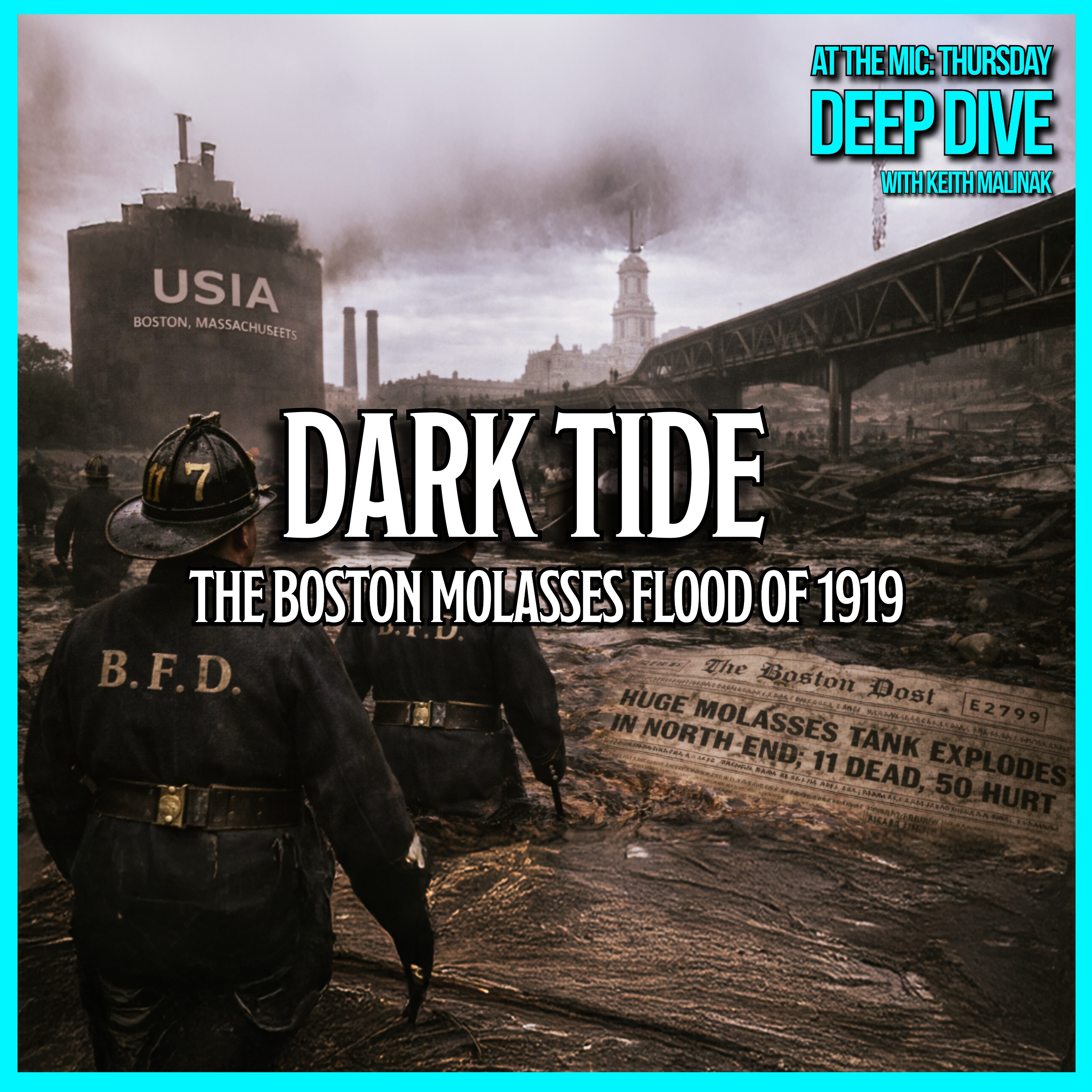






In January 1919, Boston was struck by one of the strangest and deadliest industrial disasters in American history, when a massive molasses tank collapsed and sent a deadly wave through the city’s North End, killing 21 people.
In this At The Mic: Deep Dive episode, Keith Malinak is joined by historian and author Stephen Puleo, whose book Dark Tide remains the definitive account of the Boston Molasses Flood. Together, they explore the corporate negligence that led to the disaster, the human stories behind the tragedy, and the landmark civil trial that followed, one of the earliest cases to hold a corporation accountable for public harm. The discussion also explains how the flood permanently reshaped American building codes, safety standards, and the legal relationship between corporations and the public, revealing why this overlooked moment in history still matters today.
Chapters:
- 00:00 Why Forgotten American Disasters Matter
- 10:17 The Day Boston Drowned in Molasses
- 20:12 Corporate Greed and a Tank Never Tested
- 28:10 Blaming Anarchists to Escape Responsibility
- 30:34 The Moment the Tank Collapsed
- 35:53 Rescue Efforts and the Human Toll
- 40:13 The Trial That Changed Corporate Accountability
- 45:02 How the Flood Reshaped U.S. Building Codes
- 50:15 Cleaning a City Buried in Molasses
- 53:07 The Victims’ Final Moments
- 55:34 The North End and Italian Immigrant Resilience
- 59:23 Why This Story Still Matters Today
Don’t be like the molasses company, neglecting basic responsibility. Follow At The Mic for more Deep Dives into overlooked American history.
Follow, Listen, and Connect:
- At The Mic w/ Keith Malinak
- YouTube, X, Instagram, Rumble, and all major podcast platforms
Produced by Wes, 2nd Floor Studios
Support this podcast at — https://redcircle.com/at-the-mic-with-keith-malinak2022/donations
speaker-0 (00:05.07)
you
speaker-0 (00:38.286)
And stand, yeah, yeah, yeah,
speaker-0 (01:01.71)
you
speaker-0 (01:14.017)
If I could paint the sky Would all the stars be shinin' up on the wind
speaker-0 (01:46.742)
you
speaker-0 (01:59.038)
I'm hating forces all the time, I'm all right I'm hating forces all the time, I'm hating forces all all right
speaker-0 (02:24.377)
you
speaker-0 (02:40.332)
Black out days
I don't recognize you anymore
speaker-0 (03:22.382)
Can you fall from the sky?
speaker-0 (03:27.966)
See the world from the side
speaker-0 (03:34.67)
It's It's in the way Just like an hutch and status, yeah But I like to live without a trace Blowing all to outer space See you later Now I'm gone So long not soon When I'm status Tell me when I'm
speaker-0 (04:08.863)
Stop, and tell me what I want
speaker-0 (04:21.075)
See how you fall like a child. What's in glass?
speaker-0 (04:34.062)
It's annoying Just like an art Just not a scaaaake I'm not doing without a trace What's recorded in the realest ceiling? Now I'm gone so long I'll see you when I'm staaaa
speaker-0 (05:07.854)
Star, tell me when I'm home
speaker-0 (05:18.926)
Tell me when I
speaker-0 (05:52.91)
Stars, tell me when I'm Stars, tell me when I'm home
speaker-0 (06:14.294)
Tell me when I'm inside
speaker-0 (06:36.206)
you
speaker-1 (06:49.923)
One, two, one, two, three.
speaker-0 (07:13.87)
Now baby you're castin' your spell on me You got me doin' funny things like a clown Just look at me
speaker-0 (08:12.43)
I just stand there in a trance I can't move, you're a groove Would you believe it, oh girl, that I'm crazy about you? Now go, now get your bed still
speaker-0 (08:38.83)
Now my baby's got the spells on me. Ooh, ooh, ooh, now mercy, mercy on me. All right.
Earrings, long hair and things You got style, girl, that show is wild You are that cute, tent, coke, and you're standing in pose And you got soul, you got too much soul I just said, t'knock-a-boo, said t'knock-a-boo, said t'knock-a-boo Not got to miss braille or mean
I say, Sagaka Boo, Sagaka Boo, Sagaka Boo, not casting a spell on me. I say, Sagaka Boo, Sagaka Boo, Sagaka Boo, not casting a spell on me.
You You
speaker-1 (09:55.778)
Hey, hey, hey, welcome to this edition of At the Mic. I'm your host, Keith Malinak. And I missed you guys last Friday while I was out of town. So thank you for coming back here on Thursday. I have an exciting show today that I cannot wait to get into. Before we go any further, though, I want to give a shout out, as always, to Wes at Second Floor Dallas.
on X and Gabby at Jeffy Apologist on X. Nothing but the top of the line graphics for this live stream. Be sure to follow them. West, of course, does all the thumbnails, make sure the show is available all over the place. And Gabby runs the deal over at Instagram where you can follow along at the Mike show. So please be sure to do that. We're back to normal now with the Thursday and Friday. Tomorrow we'll do the Friday live stream with the gang. And then on February 25th,
We will start a Wednesday, 3pm Eastern live stream. So by the end of this month, we'll be here on Wednesdays, Thursdays and Fridays at 3pm Eastern. Hope you'll make time. And if 3pm Eastern doesn't work for you, then you can join us whenever it does. Available obviously on YouTube at at the mic. And then X here at Keith Malinak, rumble. goodness, Wes puts it everywhere. Spotify, Apple.
You have no excuses. You can find us if you want to. Now, I found an author and I feel so late to the game on this. you know, there's so much to talk to this guy about. And we will get to one specific story in history with him. But if you know anything about me, you know that I love American history or underrated stories in American history. Hell, I've got the most underrated president of all time.
hanging back here in Calvin Coolidge. So obviously, I do enjoy reading a good book about American history, especially if it's something that doesn't get its due in the history books. And I ran across a story, I don't even remember where I found this. But we're going to talk about Darktide, the Great Boston molasses flood of 1919. Author Stephen
speaker-1 (12:18.616)
Pooleo will be joining me here in just a moment. But before I bring Stephen out here, I must say, I'm just gonna bring him out here and say it to his face because I tell you what, Stephen, thanks man. Thanks for making time. I can't hear you. You don't hear me? boy, we lost audio. Let me see if you're the only one that can't hear me. shoot, it might just be you Stephen.
Let me pull you down there. We did the pregame show, Stephen and I, and we heard each other just fine. So I don't know, Stephen, if you want to back out and then come back in to the website here, because I see people in the comments that are responding to what I'm saying here. So it sounds like there might be an audio issue on your end. So maybe back out, come back in, and let's see if it fixes itself.
Shoot, I hate to hear that, because I definitely want to talk with you today, Stephen. So maybe if you could just back out of your browser and come back in, I can bring it back up here. Do you want to check now? Check, check, check. Can you hear me? No? Hey Keith, I can't hear you. I can see you, but can't hear you. yeah. And so when I say, I don't know if you can hear me, can you? Yeah, I can. I can. Yeah. So let me write a quick note here.
Reconnect hang on. This is this is live. See we don't reconnect reconnect for us there Steven Maybe maybe that'll fix it. Okay, so uh, obviously this is part of the fun of being live But I want to tell you about the many books that that Steven has written in addition to dark tide because dark tide this was his first This was his first book and this this it came out in 2003 and then I know that
when he wrote this. I think even still, this is the case. And I'll make sure to ask him. Let's see. Stephen, any luck now hearing me? No? Check, check. Uh-oh. We lost him. Oh, no. This is one of the few books on this topic that has been written on the great Boston, Alaska's flood of 1919. And it's
speaker-1 (14:42.046)
such a an important story in our nation's history because of some of the regulations that came out of this and obviously I like as little government as possible but boy after you read this book you see where it was definitely necessary with regulations that they came out of this. Stephen how about now any luck now? I can hear you loud and clear. All right man okay so
I was just telling everybody how you wrote this book, Dark Tide, and that was back in 2003. And I don't think, how many books have been written on this subject? I feel like yours stands alone practically, right? Yeah, I'd omit the word practically. So as far as what I'll call adult nonfiction, Dark Tide was the first and still remains the only. There have been several children's books.
some fiction, some non-fiction, know, geared mainly, I would say, to middle school readers. But yeah, Dark Child was the first and so far so good 23 years later. Very good, I tell you. It is fascinating. And the fact that it is true history and for whatever reason fell through the cracks in American history. And this is what I was saying.
See, I hate it. You missed my awesome intro of you, Stephen. You didn't get to hear me praise all of the underrated history that you bring to life in your books. And obviously, we're going to focus on Dark Tide today. But I was looking up. I had no idea of the USS Eagle story that a Nazi U-boat sunk off of the coast of Maine back during World War II.
That's a fascinating story that I can't wait to read your telling of it. That was, we didn't even know about the truth of that until 2001. Right, so the U-boat sinks a US warship four miles off the coast of Maine in 1945, April of 1945. And that was very, very late in the war, two years before the surrender, German surrender, two months, I'm sorry, before the German surrender.
speaker-1 (17:03.406)
And so what happened was the Navy really covered it up for about 60 years until it finally in 2001, you know, gets revealed that it was due to enemy action as a result of a torpedo. Yeah. And I was just, like I said, man, I've got some catching up to do and I'll readily admit this, but you wrote a book, American Treasures, which I mean, that sounds fascinating. Just the premise itself is
We just never really think about, and I just, I love the way you think, man. We never think about our most sacred documents and how have they survived over the years, like the Declaration of Independence, the US Constitution, the Gettysburg Address. And I think, like I said, I haven't read that book, American Treasures. I think you tell the stories of,
the different hands that they've gone through for protection over wartime and chaos, right? Yeah. And the premise of the book really was that these documents, the original declaration, the original constitution, Gettysburg Address and several others were moved out of Washington, DC after Pearl Harbor because of fears of, you know, a Japanese attack on the West coast, but a German sabotager attack on the East coast. We just talked about the USS Eagle, right? Right. And so they were moved out of
DC and the original constitution, the original declaration, Gettysburg Address, Lincoln's second inaugural, they're all moved to Fort Knox, Kentucky for safekeeping. And then thousands of other documents have moved out of the Library Congress to different universities, repositories inland. And so that's where the jumping off point for American Treasurers is. But yeah, then I go back through the creation of those documents and how they're preserved.
throughout history. It's really, I think, a pretty fast moving narrative and I think really interesting. Stephen Fulio, my guest today, a very prolific author. And I will say that I somewhat know the story of The Caning, another book that I'm behind on reading. I just started it on my trip and I just...
speaker-1 (19:19.086)
Again, man, your writing style is just phenomenal and I'm kicking myself that I didn't discover it sooner. And I know that your latest book is The Great Abolitionist. Am I wrong to think that the caning, which is an assault on the house floor back during, just before the Civil War, Charles Sumner and Preston Brooks, is this kind of maybe part one of The Great Abolitionist, the Charles Sumner story?
Yeah, well, let me say this. It certainly included in part one, but after I finished the caning, I knew in my head that I wanted to do more about Charles Sumner, abolitionist senator from Massachusetts. Ended up writing two books in between, but couldn't get Sumner out of my head. And, you know, just realized that he had done so much more. So the caning basically stops with the beginning of the Civil War. So with the attack on Fort Sumter.
The Sumner biography, the great abolitionist that came out in 2024, covers a little more of Sumner earlier in his life, but also covers him during the Civil War, you know, with Lincoln's assassination. He was very close to Lincoln, was at Lincoln's bedside the night Lincoln was shot, and then some of his work during Reconstruction. So it's really the first full biography of Sumner in over 50 years.
I think he's been really neglected in history, so I felt like I had to tell his story. Absolutely. Yeah. I mean, just a crazy story. I and I often actually do think about that event in the US Senate when things get crazy in our modern world and our politics get very loud. I often think back, I was like, hey, well, at least we're not beating the hell out of each other, you know, to near death on the floor of the Senate. So, okay.
So please check out his books, Stephen Puglio, what led me to, before I go any further, I know how busy you are. I know how difficult it was for us to coordinate schedules. And I know that you're writing a book right now. When are we gonna see that? And do you wanna give us any taste about what we can expect coming up from you? So I'll just say my ninth book, my manuscript is due on March 1st. My guess is the book will be out in 2027.
speaker-1 (21:38.51)
the topic has not been announced yet, will be very soon. So, I would just urge anyone who wants to either go to my website, on my mailing list, you can do that through my website, and I can let folks know. And Keith, to your point, I'm really thrilled to be here as well. So, really, you know, I've seen some of your stuff. It's very, I think it's interesting. I think it's conversational, which is the stuff I like. I've made 735 appearances as an author.
So I love talking to readers. That's awesome. Well, talking about books, et cetera on your next book tour. I don't care what the topic is. I have confidence, confidence in buying that stock. If you want to come back and promote your next book, please. Sounds good. Sounds good. OK, sir. Dark Tide, the great Boston molasses flood of 1919, Stephen's first book. And just it's it's captivating from start to finish. And you can't even believe it's real.
Like you're reading this story and it just, you have to keep reminding yourself that this actually happened. And I've read the book, I've seen a presentation of yours on this, and I don't know where you want to begin in the story. I'll say this. In 2024, I was in Boston and what a great, my gosh, I had no idea what I was missing.
What a great town Boston is. Where are you, Keith? Can I ask? I'm in Dallas. I was born and raised in Atlanta. OK, cool. And I went to the University of Nebraska. And so I just really never spent any time in the Northeast. I did live in New Jersey for a couple of regrettable years, but I had never gotten up to Boston. And as a Southerner, I just figured, it's a Northeastern city, whatever. But my wife and I went up there.
And we saw all the foliage there in the fall of 2024. The weather was perfect. We walked. mean, we we wore out our shoes walking through Boston and you get to the north end and and and it's a hike from all the rest of the stuff there. But it's just this beautiful setting. And I knew I already read your book at that time and and I I knew what I was looking at. And it's just
speaker-1 (24:00.866)
fascinating to believe that what is there today and the destruction that was there a hundred plus years ago. It's just like a completely different different world. And I did try to smell the air. I was trying to see if there was any of the molasses. No, that's long gone, long gone. But it lasted for decades. So why don't you why don't you just pick up the story where you want? Because I know you're great at telling this and I'll jump in wherever I have some questions. How about that?
Yeah, no, that's fine. And first, I'll say this. Glad you enjoyed the city. It's a great walking city, Maybe unlike Dallas, but yeah, it's a great, it's small enough that you could cover, Boston is, you can cover a large part of the city in a day of walking. so- And the history is just phenomenal. It is, it is. Great revolution history. And you're in the North End, great Italian immigrant history, my heritage. You're in a great little-
almost European like little Italy when you come to the North end, which is where the molasses flood took place. I guess I'll start on the day and then we can kind of do it however you want. But January 15th, 1919, it's what we call here in Boston, unlike you guys in Atlanta and Dallas, it was 40 degrees. That's a spring thaw, you know?
Yeah. It's been freezing up here. So as it was prior to the molasses flood itself, but on January 15th of 1919, a large molasses tank, when I say large, 50 feet tall, 90 feet in diameter, capable of holding 2.3 million gallons of molasses, gives way, collapses, disintegrates, and causes a massive destructive, deadly flood.
in Boston's North End. So 21 people are killed in this flood, 150 people injured, some of them very seriously, enormous property damage in Boston's North End. An overhead train trestle was destroyed by both the molasses, the force of the molasses wave itself, and the steel pieces of the tank that had disintegrated. Horses are killed in the Great Boston Molasses flood that are stored, that are housed or stable.
speaker-1 (26:19.936)
along the waterfront, municipal owned horses. So it's a real tragedy. The deaths are awful. People asphyxiated molasses, smothered in molasses. It's horrific. Killed by debris, whether it's wood, stone, barrels of rum, anything that get caught up, essentially in what is a mini tidal wave of molasses.
One of the most unusual, I think, disasters in all of American history, know, at the root of it is lots of corporate greed, you know, mistakes, those kinds of things that, you know, sometimes we're accustomed to, sometimes we're shocked by. And I think a story that, you know, has really captured the people's imagination when they read this book and when they hear about the story. Yeah, yeah.
The corporate greed angle for sure is part of that. And I found it kind of ironic that the run up to prohibition also played a role in this. it's just everything kind of came along there at that perfect moment. I want you to talk about how do they test that tank, Stephen?
How, what, what, cause that, that seems to be where the biggest finger pointing, rightfully so, and the blame goes just to the origination of the tank, yeah? Yeah, I think, I think it's probably best to start like, why was the tank there? And then, right, it built. So, the tank is constructed by a company called US Industrial Alcohol, private company with US in the name. And it's built right on the Boston waterfront.
And it's designed to house molasses that would get brought up on these large molasses steamers from Cuba and Puerto Rico and the West Indies. It would be stored there and then offloaded as needed and processed into industrial alcohol at USIA's plant about a mile away in Cambridge, Massachusetts. Now normally industrial alcohol is used in things like dyes and lacquers and turpentine and things like that. But
speaker-1 (28:43.374)
during wartime, World War I, this was originally built in the fall of 1915. During World War I molasses is further processed and used in the production of munitions like TNT, nitroglycerin, things like that. So USIA has had as its biggest customers, the big munitions producers around the Northeast mainly, the British and French governments before the US gets into World War I.
And then the US government, once we get into 1917, molasses is a war protected industry during the first world war. I would say about 95%, 90 to 95 % of the molasses stored in the tank on the Boston waterfront was processed and then used in munitions. And then to your point, once the armistice happens, the war ends in November of 1918, two months before the flood.
and and
Don't ban my alcohol. Yeah, I know. To ratify the Prohibition Amendment, and it was going to go into effect one year later. Right. Right. January 20 of 1920. January 17 of 1920, one year later. And I learned from your book, and I had forgotten until you just reminded me, I had forgotten of the importance of
of the process there during World War I, that the tank was to that munitions and all of that stuff. And then the irony of all ironies there, like you said, the prohibition, you know, whatever, what is it? Three-fourths of states, I forget. Yeah, three-fourths. It's on the same headline, like the papers of the molasses flood. You know, that's just a snapshot in history, but they're actually kind of connected. Well, I think what's remarkable is if you look at the
speaker-1 (31:06.062)
there was seven Boston newspapers at the time, right? And if you look at those papers, in every single paper for about a week, the molasses flood knocks off the front page prohibition and the Treaty of Versailles that ends World War I. So those have kind of moved inside while the molasses flood kind of captures front page news. Right. Okay. So the tank was originally built in 1915 and you mentioned this earlier and I want to emphasize this.
you say 2.3 million gallons, right? Which is 26 million pounds. Is that right? It is. I think the best way, know, those of us, you know, which is all of us who think of molasses as like a grandma's molasses jar, maybe that you pick up at the grocery store, what's 2.3 million gallons? What is that equal to? And one of the lawyers in the huge civil lawsuits, landmark civil lawsuit that follows,
says that the weight in that tank at least, and this is a steel tank held together with thousands of rivets, the weight in that tank is the equivalent of 13,000 Ford automobiles of the day. So it's a Model T Ford he's talking about. Picture 13,000 of them encapsulated in that tank. That'll give you an idea of the weight of the molasses in the tank. Yeah, and I do wanna make sure that...
we have time today to talk about some of the courtroom drama that gets detailed in the book. let's talk about this tank because I still cannot get over how they tested this thing. you know what, maybe you'll want to do this. Who was it? Was it the guy who designed the tank? He just had no business even doing it.
So I think if there's a villain in this story, a real life villain in the story, it's the treasurer of United States Industrial Alcohol, Arthur P. Jell. Now Jell was a great finance person, I'm sure, but he's put in charge of this tank, the construction project of this tank and kind of managing the tank once it's launched. And so the tank is built in the fall of 1915.
speaker-1 (33:24.526)
in order to be ready for a steamer that's coming up just about New Year's Day of 1960. And so it's built very, very quickly. Yeah, that deadline was impossible. Very shoddily. Rivet holes were not plumb, as the expression goes. The rivets, the thing leaks almost immediately. From day one, I'm not just talking about little tiny leaks, I'm talking about like 50-foot streams of leaks. The steel that was delivered was below specifications.
never tested. Gel does not consult any architect, any technical person, any metallurgist, anybody of that nature. Doesn't really know much about a factor of safety. You know, how strong those walls should be with all that molasses pushing against them. Doesn't do any of that. And then puts the thing in operation. Once in operation, he gets complaints from a man who works for him, one of his employees that
people are complaining about the leaks. And so at one point he has the tank painted from a steel blue color to a brownish red color, which kind of camouflages, though not totally, the molasses leaking down the side. Incredible. Yeah. And then I think the other thing is he testifies in court later, the contract called for the molasses tank to be filled with water upon completion to at least test it for leaks, if not for weight.
So 50 feet of water. And so he testifies in court after that they filled it with six inches of water. Six inches because they had nine of the time with the money. And so he takes it up past the first angle joint basically and then pronounces it ready for use at that point. So it was not tested properly at all. And it was overseen by somebody who really did not know what they were doing. But now obviously.
there were several people in the neighborhood, especially kids, but many people who would come up to the tank and gather with their pails, the free molasses that would flow out of the cracks and the crevices, right? But there were people who were very concerned about that tank from the beginning, yeah? Yeah, so one of the, I would say one of the heroes of the book,
speaker-1 (35:48.142)
is a gentleman by the name of Isaac Gonzalez who works for Jell, by the way. He's more or less a jack of all trades at the tank. He helps the steamer people hook their hoses up when they offload, he cleans up around the tank, he does all of that kind of thing. And he's the one that warns Jell and is pretty much told to keep his mouth shut or he'll lose his job. And Isaac in the summer of 1918 is so distraught.
because he envisions some kind of disaster that he takes to running through the streets of Boston from his home in the South End, cross town all the way to the North End at about 2.33 o'clock in the morning. He does it about five times in the summer of 1918. Onto the tank property, goes around to the back, opens up a valve and let some of the molasses out back into the harbor. And he testified in court later that, you know, this was his way
of trying to prevent this major disaster. He also testifies in court on what a stress this was placing on his marriage because his wife didn't believe that's where he was going at 2.30. There's lengthy testimony of him doing that, of talking about how stressful this was for him. Yes. That is so good. Yes. Okay. Cause he tries to warn.
his boss is like you said, yeah. And, and they just don't care. And I guess you alluded to it earlier, the greed on the part of this company, USIA. My goodness, that this is. And well, we'll get to once we get through the story here, I want to talk about how
how this has affected regulations in this country ever since then. And before we get into the destruction of the town and the deaths that were so avoidable, I at least want to throw out the theory that USIA tried to posit in that anarchists were big at the time. Communists were causing trouble.
speaker-1 (38:06.156)
So explain how they tried to pin this disaster on somebody else and how, know, it almost seems like a plausible story. Yeah, it does. I mean, one of the things about Dark Tide that people have told me they enjoy, I'll just lead into it this way, is that the book works on two levels, right? There's sort of a narrative drama of the flood itself, which is the disaster, you know, which is the cleanup, which is the hospital scenes, which are the courtroom scenes at the end, the big civil lawsuit.
But on another level, there's big history here that literally touches the flood story. The munitions business of World War I, the immigration business, because this was a community of Italian immigrants, most of whom couldn't vote, most of whom had very little to say, for example, when this tank was plunked out in their neighborhood. But the anarchists is another one of those. The anarchists were very violent. They were very active during this time. They bombed munitions plants. They bombed government buildings.
They bombed a police station in Boston's North End. In April of 1919, just a couple of months after the flood, they bombed, they set off bombs simultaneously in seven cities across the United States, including the attorney general of the United States home, Abe Mitchell Palmer. And so they were very active at this time. And so one of the things the USIA defense attorneys do in the courtroom scenes that follow is that they blame it on anarchists. They blame the
the collapse on an anarchist putting a pipe bomb down a vent pipe at the top of the molasses tank and causing it to explode, therefore they should be absolved of all liability. And so the only thing they're missing is evidence of that. There's no evidence of a concussive explosion, no evidence of a bomb, but when the court case begins in September of 1920,
Just about the time of the opening statements by the attorney, the defense attorneys, a bomb explodes in New York City at lunchtime on Wall Street in front of JPMorgan's headquarters and kills 42 people in anarchist bombs. So it's almost in a way like a fortuitous coincidental event for USIA's defense that they're trying to put on.
speaker-1 (40:30.282)
Okay, let's go to the day of the tank collapse. Let's kind of set the scene there near Cops Hill. you referenced the train trussle earlier. The firehouse was what? Yep. 80 feet away. Yep. And there's some drama that unfolds there during the telling of the story.
I guess that morning there were some creaks and groans, right? If I remember correctly, like people knew something was up that day before the actual event, yeah? Yeah, so just setting the scene, you're absolutely right. Matter of fact, every time the tank was filled to capacity, it would groan and moan and people would wonder and it would leak. And the tank had been filled to capacity just two days earlier. So it was that full 2.3 million gallons in the tank. So just to set the scene.
The tank, as you point out, is about 80 feet from the firehouse right on Boston Harbor, whose fire personnel were responsible for putting out fires on boats that were moored in the harbor, for the most part. There's what I would call like a Department of Public Works or Public Works, huge North End Public Works area where there was a blacksmith's shop, a carpentry shop, stables in which the horses were kept, the municipal horses.
So very, very active. not only that, almost all the shipping that Boston had from up and down the East coast into Europe left from this area. So all day long, these deliveries of leather goods and rum and produce, everything Boston produces to be shipped. So it's a very busy, active kind of time. Like I said, 40 degrees, people are out. The VPW workers are out.
Firefighters are playing cards. It's right around lunchtime. So they're on their break. And a Boston police patrolman by the name of Frank McManus is walking his regular beat along Commercial Street and coincidentally enough is making his routine call back to headquarters from the call box at the time that was on Commercial Street. When all of a sudden he says, he hears, he testifies in court later that
speaker-1 (42:54.252)
He hears this tremendous rumbling grinding sound and the rat tat tat of what sounds like machine gun bullets. Turns around, the rat tat tat of these thousands of rivets ripping away, turns around and sees the tank disintegrating and this huge wave of molasses, disgorging from the tank has the presence of mind to make one of the most unbelievable calls back to Boston police headquarters ever.
He says, send all available rescue personnel immediately. There's a wave of molasses coming down commercial street. Can guarantee you they haven't had a call like that since at Boston police headquarters. And the wave comes very hard and very fast. So the phrase you're as slow as cold molasses in January does come from this disaster, I can say. it comes, this molasses leaves the tank
at about 35 feet high and about, at about a hundred and it settles at about 120 feet wide and at about 35 miles an hour. And eventually levels off to about 20 feet high. So 20 high, 160 wide and just scours, picture it as, you know, a tidal wave, a small tidal wave. It reverberates off of Copse Hill, which kind of slopes down towards the tank and towards the harbor.
good thing if it's sloped the other way, might have been thousands of deaths. Thousands. You've been in that neighborhood, you know. Yeah, I was just trying to think in my mind. Yeah, approaching that. it goes right fortuitously toward the water. Yeah. Yeah. So it basically kind of recoils off Cops Hill and goes southward for about a mile and and scoops up everything in its path. Okay, so so let's go through these numbers again. So it covers about a mile. Yeah. And at its let's see.
You said 35 feet high and it comes out at 35 feet. Comes out and it was going 35 miles per hour. Yes. So imagine that if you're right at the tank, it's 35 feet high, 35 miles per hour. You don't stand a chance if you're anywhere near the tank. It covers at varying degrees, a miles worth of area there, right? And then what was the 120 feet? About 120 feet wide, which is the whole width of commercial street, maybe even bigger.
speaker-1 (45:20.078)
So it's going right down the street. People are literally trying to outrun it, if possible. Yeah, it's like if you wrote this into a script, people wouldn't even believe it. so rescue personnel get there fairly quickly. The first rescue people are the people who are sailors on the ships that are moored right there in the harbor. So they're able to come. Firefighters get there pretty quickly.
molasses is so deep, probably hip deep, that they have to lay their ladders flat, horizontally flat on the top of the molasses to go out and try to rescue who they can. So for example, one of the children that are killed, there are two children killed, both 10 years old, Maria d'Eustacio, who was at the tank, as I think you pointed out earlier, scooping up molasses that had pooled around the bottom of the tank.
Firefighters literally see her hair on the top of the molasses, pull her out, but it's too late, she dies. The firefighters that are in the firehouse playing cards, the wave strikes the firehouse and the second floor pancakes down onto the first floor traps four firefighters underneath in about an 18 inch crawl space. And one of the firefighters, George Leahy, is desperately trying to keep his head above molasses.
He's under there for four hours, can't do it. finally succumbs, asphyxiates in molasses. So there's these terrible stories. Yeah. And you paint such a picture of a lot of the victims. I don't even know where to begin. I was just looking through some of the victims here. You mentioned the two children. mean, there was a who was the individual who survived a week.
But he was so scalded, I guess. Am I forgetting that? Well, might. I don't know if you're thinking maybe of John Barry, who's also trapped under that firehouse. OK. And he's actually rescued after four hours. while he's under there, rescuers are able to. There's a little channel they're able to make. They're able to inject his spine with morphine and feed him a little brandy.
speaker-1 (47:43.342)
give him a little brandy and they finally get him out. They take him to the nearby hospital where they took the victims and his grown daughters visit him this afternoon and they don't recognize him because his hair, which was brown when he left the house in the morning, had turned this snowy white. He had fractured his skull and his back. He was a stone cutter visiting his firefighter friends at the firehouse at lunchtime. And he does live, but he never cuts stone again.
You know, he's disabled for the rest of his life. Yeah. okay. Yeah. I'm just looking here. Yeah. That was a blacksmith. Yeah. Just, these stories are just devastating. I mean, the two 10 year olds you talked about who were walking home. mean, yeah. we got, a longshoreman who was napping. I mean that, that may have been the best way to go. Just, yeah. okay. Yeah. It just, my gosh, trapped under beams.
see a lot of this stuff because I read it so far back I'm just kind of remembering and just checking out my notes it's just devastating stories one after another well and I think also you know some of the drama even later you know when it's quiet on the waterfront about 25 horses are killed in the flood about half of them are killed by the wave itself the other half are shot by Boston police that night because they're so enmeshed in molasses they can't get out so they're
essentially put out of the misery that evening so that it's quiet on the waterfront except for these gunshots that reverberate around the waterfront. So there's this really eerie sense after the fact as well. Yeah, let's see here. So it was two degrees on January 14th, then it spiked 41. Yep. That's incredible.
Yeah, OK. I'm just, I'm seeing all my notes now. I'm like, yeah, yeah, it's all coming back to me. It's just an incredible book. And it's written so perfectly. And it's just so vivid. Let me see here. Yes. All right, so take us to the trial. Because you have a judge there who, I mean, this guy is, he's a good guy. He really makes sure that justice is served as best it can be.
speaker-1 (50:09.772)
Yeah, so the judge of the case is a gentleman by the name of Hugh W. Ogden. He's a very prominent lawyer in Boston. And the Superior Court asks if he would hear this civil lawsuit. There are 119 plaintiffs who go up against US industrial alcohol, still one of the largest civil lawsuits in Massachusetts history, one of the real first class action lawsuits that we would call it. And so Ogden is asked to
hear the case and the Superior Court estimates that maybe, maybe it would take about six weeks. It takes three years to finish. It's a gigantic case. are a thousand witnesses, 1,500 exhibits. Think about that. It's the first use of expert witnesses on each side, chemists, architects, metallurgists, all of that. And so it's a huge, huge case that Ogden hears.
And at the end of the day, he rules in favor of the plaintiffs. Trust me, had he ruled the other way, would not have been any shock, any outrage. think it would have been almost expected. But he rules against United States Industrial Alcohol, finds them liable. No criminal action. A grand jury does sit on this case, returns no indictments because no laws, essentially, were broken, which I think-
So which I think is accurate, which I think is proper. So this is a civil lawsuit. Important to note that. And as I said, Ogden, think, really goes through the evidence. And I think in a way bends over backwards to treat the plaintiffs fairly. One of my favorite examples of that, by the way, is that Ogden asked the lawyers in the case if they would be willing to have court in session.
on Saturday afternoons because most of the plaintiffs were laborers who worked at least five and a half day weeks. The lawyers for both sides say no. Both sides say no. They actually live outside the city. They don't want to come in on the weekends. In the summer, they have summer homes. They don't want to come back. And so Ogden says, okay, in that case, we're going to keep court open till 10 o'clock at night when
speaker-1 (52:31.744)
necessary and there are many sessions of the great Boston molasses flood court case in which testimony is taken at night up until 10 o'clock as a result of that. I think he does justice for the victims and I think his ruling is supported by the evidence, I think, really very much so. In fact, at one point when the plaintiffs, I'm sorry, the defendant's lawyer, the company lawyer is talking about the anarchists,
At the end, Ogden says to him, his name's Charles Choate, Ogden says to him, brother Choate, you put on a very good circumstantial case. The only thing you were missing was evidence, which I think is a great line. Yeah. Yeah. And you make the point, there just weren't laws at that time. But that really changed. Refresh my memory, Stephen, on the building codes at the time.
how they were able to get away with the shoddy craftsmanship of the tank. Because if memory serves, since it wasn't technically a building, was a store. What was that again? Yeah, no, you are correct. It did not require a building permit. Not that building permits at the time required many great stringent rules and regulations. But this did not require any building permit because it was considered a receptacle.
and not a building. So yeah. And so I think I think this case, if you if you look at it, has this huge these huge I don't know if you want to get into this now, but these kind of huge nationwide ramifications. And I do want you to talk about the nationwide ramifications, because I don't know, maybe six, eight months ago, I had a conversation on here about the Ludlow massacre. And kind of from that.
lesser known story in American history. told you I love these. That's where really there was a sea change in the labor movement from from what happened in Colorado around this same time actually. So talk to us about the larger ramifications on just the judicial system and building codes that came directly out of the Boston molasses flood. Yeah, I think
speaker-1 (54:57.998)
Yeah, I think it's great story. So if you look at when Ogden renders his decision, he renders it in 1925. That's when he renders his ruling against United States industrial costs. So I want you to think about the 1920s at the time, the roaring 20s. know, things are going well economically. There's lots of activity in the country, lots of capital being lent, lots of building going on.
Consumers are purchasing things like irons and toasters for the first time in great numbers. The fledgling auto industry is underway. know, the first ads for newspapers happened in 1922, right around there. But at the same time, there's this feeling of in the midst of this economic boom, you know, how do we better protect workers and the public? And this is around the time that Upton Sinclair writes the jungle about the Chicago meat packing plants and some of the, you know,
issues out there. So if you look at Ogden's decision in 1925, it's really the first major decision against the large United States corporation on a civil basis. And if you draw a line right there and move forward, right, the late 20s, after the stock market crash in 29, during the early Roosevelt years, the entire relationship between government and business changes. There are far more regulations.
rules, laws, statutes that government imposes on business. Now, some people will say in the intervening decades, that pendulum swings too far one way, too far the other way. And I think that's true. But there's no doubt it all changes because of this great Boston molasses flood lawsuit. And I think the way we can kind of internalize it or the way it affects our daily life is that everything we kind of take for granted
in the building construction world. Architects need to show their work. Engineers need to sign and seal their plans. Building inspectors need to come out and look at projects and then approve them and give you building permits. All of that comes about because of the great Boston molasses fall of 1919. First in Boston in the Northeast and then it ripples across the country. So I would say that two Boston tragedies,
speaker-1 (57:18.702)
molasses flood case does for building construction standards, what the coconut grow fire a dozen years later, 1942, does for fire standards around the country, changes them completely. So you have these two Boston tragedies, I think, that in some ways produced some good. Yeah, and the company there, USIA,
they end up paying what $630,000, which I guess is the equivalent of 60 million today. I I found that you're right. Okay. And, and like you said, it was a it's kind of a line of demarcation on on pre this ruling in 1925 and post that ruling as far as building codes, and so forth there. I do want to talk about the cleanup.
uh going back to the actual uh 1919 I want to talk about that because one of the things I found so fascinating was how the the the the scent the aroma that lasted for decades after that especially on hot summer days yep and and how people in the and I'm kind of jumping around here but but like people would track this this molasses everywhere right I mean they just yeah so it made it throughout the city
So I could, let me start with that, which is kind of great. There's great folklore around the flood, which I find really interesting. One of the great pieces of folklore is that literally today you could still go down to the site and spell molasses. You cannot. I've been down the site numerous, many, many more times than I can count in warm days, cold days, windy days, rainy days. can't. Can I just say, I don't want to interrupt you here. I'm so sorry.
But I'm going to. When you go down there, can you also describe the scene how it's just so surreal because you have a park, like a bocce ball deal there, like there's a little baseball field. There's this gym or something where people are in there working out. is like, I was standing there wondering, do they know, does anybody know the tragedy that happened here? Anyway, Stephen, I'm sorry, go ahead.
speaker-1 (59:43.778)
Yeah, no, I can get to that too, but just that piece of folklore, it stems from the fact that yes, you could smell it for decades afterwards. In fact, I've had people at a couple of my presentations who used to read meters for Boston gas in the 1970s and said when you went down into the cellars of those buildings, now keep in mind those cellars were filled up all the way to the first floor, street level with molasses.
that you could still smell the molasses, you know, in the 1970s. And I think that is certainly true. But that's one of the pieces of folklore. The other piece of folklore, you kind of alluded to it right now, is that the entire city of Boston was covered in molasses, which is not true. You know, Boston is only eight miles, I think, from the harbor to the westernmost point, but it was not all covered with molasses. But where that comes from is that people tracked molasses
all over the city on the subways, on payphones. There's many reports of people who would pick up the receiver of payphone and their earpiece would have molasses stuck to it or the mouthpiece would have molasses stuck to it. In horse troughs that were placed around the city for horses to take a drink as they were pulling carts at the time, molasses was spread that way. So that became part and parcel of the folklore too. it's...
It's kind of an interesting way the way that developed. But the day itself, the cleanup. You know, it's very difficult. Nobody's quite sure what to do. They first hook up hoses firefighters do to hydrants. A municipal water supply doesn't really do anything. So molasses never really totally hardens, but it congeals. You know, it's very viscous. People aren't quite sure it doesn't do anything that regular municipal water.
The next day people are coming out literally with picks and chisels, but I mean the whole place is covered with molasses. So that really does very little good. So finally an enterprising firefighter has an idea that salt water, the brine from salt water would cut the molasses and allow it to be washed away. Lo and behold, that's what they do. They pump millions of gallons of molasses out of Boston Harbor, of water out of Boston Harbor and wash the molasses in.
speaker-1 (01:02:04.778)
Most of it into the harbor, it does cut and it does help that clean up a great deal. How long was it during that cleanup process before they had that idea? You know what? Saltwater might do the trick. Two days later, days later, a firefighter says, let's try this because we're getting nowhere. Essentially, mean, mean, Keith, if you drop a bottle of molasses on your kitchen floor, it's nearly impossible to to clean it up.
So yes, it's the think of that, you know. You're absolutely right. Yeah. OK. I want to ask you and you've already touched on several of these deaths. Are there any of those moments that you were writing about of people in their last moments on Earth that really just kind of stick with you, that you think about at random times after having written about again, this is the book, you know.
I mean, this is the book. This is the book, Dark Tide, by Stephen Fulio. Do you have these moments where you think back about writing some of those stories and the tragic endings? Yeah, so I think the one that sticks with me the most is Pasquale Iantosca. He's the other 10-year-old boy. And after the flood occurs, his father is trudging up and down the waterfront trying to find some evidence of where his son is. Can't find them.
He takes a, it takes a week. His father is distraught and they finally find Pasquale. He had been kind of crushed by a freight car. So there was freight train traffic right along commercial street. know, tracks placed right on the street. And one of the freight cars had kind of swept Pasquale and crushed him. And the only way that they could identify him was that his mother had dressed him in two sweaters that day. And so they were able to find his
disfigured body, if you will, a week later, they finally find evidence of him and realize he's gone. They obviously suspect it for that whole week that his dad's looking for him. But I think that's the one that sticks with me the most, Keith, of all of them. I bet. Yeah. OK. So the community is devastated, obviously. I mean, it's literally wiped away.
speaker-1 (01:04:31.854)
And I know there were a lot of breadwinners that ended up dying in this flood. How long did it take for the North End to really recover from this? Do you know? Yeah. So I would say the clean, the clean up maybe takes about six months, all of the cleanup. And that includes the rebuilding of the overhead train. The Boston elevated, it was called, essentially a public transportation piece elevated from
Boston's South Station to Boston's North Station. Picture the flood happening close to North Station. But it was almost across town, you will, elevated train track. So that whole thing takes about six months. And I believe the people in the North End, know, after that amount of time, are kind of over the flood. I mean, it's always, it's a story, it's a remembrance. But, you know, keep in mind, these are
really kind of poor working class people who have to make a living. You know what I mean? So there's not a lot of navel gazing, you know, sitting around and let's write poetry about the great Boston molasses. But you know, these are hard laborers that were trying to support families. So right. There was this initial outrage, not much, but some initial outrage the first couple of days afterwards, Boston city officials, you know, they have a little bit of outrage.
But not all that much. And even in the neighborhood, mostly the Italian community, the North End at that point is about 98 % Italian. Almost all the Irish population that used to be there had moved up and out. Almost all the Jewish population that was there had moved up and out. And then these were the poor Italians who were there at the time. Most of them weren't citizens. Most of them couldn't vote. They had very little to say about their own neighborhood. They weren't politically...
I would say politically inclined to begin with. They had great distrust of government from the time in Italy after Italy's unification and Rome's kind of oppression of the Southern Italians, which was a huge thing. The Southern Italians who come here carry that with them. So they basically mostly keep their heads down and work hard. That's what they do. So you don't see this.
speaker-1 (01:06:55.72)
maybe what we would call civic activism today, know, demonstrations today, nothing of that sort. You and I were talking earlier when I rudely interrupted you, but you know, you make all these trips down there to the North End. Do you find that I and when we went, I didn't really talk to anybody about about this event. But is this history forgotten? I know there's a plaque there.
But beyond that, they kind of got to, if I remember correctly, kind of like a superimposed picture if I, I may be misremembering. there's a brand new interpretive plaque down there that went up about two years ago. You probably came right in about the time it went up. Okay. Prior to that, there was just this little tiny nine inch square green plaque that was kind of pushed into the wall on Commercial Street. You almost missed it.
But the new plaque, think, which has photos, I edited the copy for it so that could tell you the stories accurate. Awesome. Yeah, that's good. I do a lot of tours of the North End and I do the history, the different layers of history down there, but I do touch on the flood and we get out to the flood site. And I think, you know, I'm happy to say that I think since Dark Tide, more and more people know about it. So if you take a Boston Trolley tour now, they'll talk about Dark Tide. They'll talk about the Great Boston-Malasses flood.
which is exciting. That's really cool. That's really cool, man. Yeah, I think so. All because of you. Which is the amphibious vehicles, if you saw them, that go around Boston. I've seen those in Joplin, Missouri. OK. Sorry. Oh, gosh. Is it Joplin? I think it is. Yeah. Yeah, OK. I've seen those around the lake there. And so they have those in Boston, huh? They have them in Boston. They go into the Charles River. OK. And they also drive around. And so they go to the north end.
They each have these, each of the duck tour boats, these amphibious vehicles have a name that pertains to Boston history. And the one that generally goes around the North end, her name is Molly Molasses. Yes. So yes. Okay. So I think there's this awakening and this awareness of the flood story, you know, a lot more. Yeah.
speaker-1 (01:09:19.532)
DocChad is now used in lots of Massachusetts area schools in their curriculum. that's helped, think. I work with students from all over the country. fact, I'm working with one from New Mexico and one from Minnesota now who do molasses flood projects for their big history day projects. So that's always fun. I just love it. I love that you found a story.
from an area you're very familiar with that nobody else had touched and you really made it come to life. And before I get any angry messages or what have you, I'm sorry, I meant to say Branson, Missouri. And I said Joplin. Yeah. That's yeah. Up there in the mountains. Okay. So, very good. I just, I think this is absolutely a fascinating read and I hope that everyone will take the time.
to get a copy themselves, Dark Tide, the Great Boston-Malasses Flood of 1919. And I'm telling you, I'm going to have to have you back to talk about some other your books here that no doubt are great adventures as well. And I know you're hard at work. You've got a deadline coming up for another book. And I look forward to finding out the... I saw somebody posted earlier, Stephen, that they signed up for your newsletter.
And if you sign up for that, can you get the announcement that way? Will you be telling everyone about that? The answer is yes. do about, just so your listeners know, Keith, I do maybe three or four what I call E-blasts. So they're E-newsletters a year to my mailing list. Here we go. I have a very good-sized mailing list. So I'm not spamming you every day. You get three to four really, I think.
well done newsletters. Awesome. That kind of fill you in on what I'm doing and where I'm speaking and things that have happened since the last one, etc. So you'll get that and those, yes, I'll be announcing, that's where I will announce the new book. So people should be ready for that. Also, I'm holding up the 100th anniversary edition of Dark Tide. Look at that. Which came out in 2019. So it's a, you may see this. Now, wait a minute.
speaker-1 (01:11:41.888)
Yes, so that I was just about to say you won an award there. No, well, no, this is the hundredth anniversary. Okay. So books won lots of awards, but that's not one of them. Okay. Okay. Okay. I just wanted to put out the different cover. That's cool. Yeah. So that's really great. Steven Puglio.com. If you're if you're listening, it's a T E P H E N.
sign up there and be sure to get the announcement in the very near future of the next book there. can't wait to find out what that is because I know I just know based on the subject matter that you pick that it's going to be something worth reading. Is there anything else that you want to share with us whether from this book or anything else in history because I just love
just listening to you tell the stories by all means. If there's anything else you want to get out there. Yeah, no, I'll just say this, Keith. This is my 25th anniversary as an author. Actually, 2025 was. So I've completed the 25 years as an author. And I just want to say thanks, man, to readers. I have wonderful, loyal readers. And they come to my events. I've made 735 events.
Appearances as an author they come to my events. They buy my books. They follow me on socials and online and You know, I would say the greatest emotion I have is gratitude. So people have many demands on their time many demands on their money and so when somebody chooses to buy one of my books or come to one of my events it really really does mean a lot to me and That's great. I get an opportunity to meet thousands of readers to talk to people like you. I mean
I'm very grateful and very blessed. Well, you're awesome, man. And you know what? Let me let me say this or let me let me ask you this. And and then and then when we hang up, don't don't disconnect yet, Steven, because I have a I have a topic that I want to give you that you might be interested in writing a book about. But anyway, but here's what I want to ask you. I don't want you to give away the material at all. OK, so please don't misunderstand what I'm saying. Do you have a running list in your mind or maybe on a three by five note card somewhere?
speaker-1 (01:14:06.262)
of stories in history that you're like, I need to write a book about that one day. I need to write a book about that one day. Do you have that? Yes. You draw somewhere? Awesome. Cool. well, I'm going to my idea file and that's where it is. Yeah, I love it. Well, I'm going to I'm going to wish everyone a great rest of the day. We'll see you tomorrow at 3 p.m. Eastern. But after I say goodbye to you, I'm going to check and make sure that there's this one American story in my head that I want Stephen to be the guy to write about it.
I don't want anybody else to hear that yet. anyway, Stephen Puello, Puglio, thank you so much for making time. Go and check out any number of his books. They just look fabulous. Dark Tide is what we talked about today. And thank you for making time, sir. Thanks, Keith. I really enjoyed it. Thank you. Thank you.


