
The Frontier That Still Shapes U.S. Power | 3/4/26
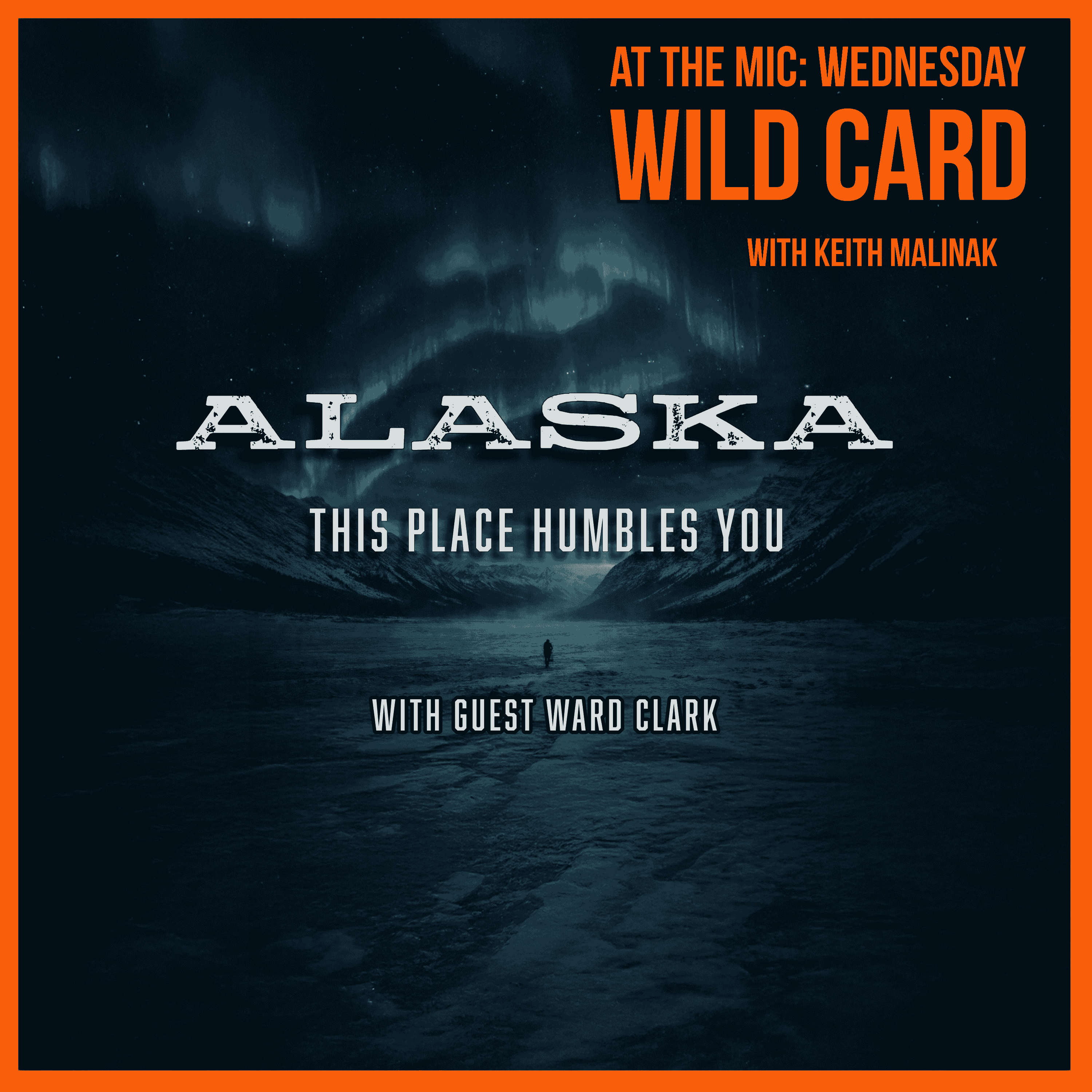






Alaska was once mocked as “Seward’s Folly.” Today it sits on massive oil reserves, critical military positions, and one of the most fascinating histories in North America.
In this episode of At The Mic, Keith Malinak talks with Alaska resident and writer Ward Clark about the strange and often overlooked history of the Last Frontier.
From ancient land bridges and Russian imperial politics to World War II battles fought on American soil, Alaska’s story reads more like a thriller than a textbook. The conversation explores the purchase of Alaska from Russia, the Aleutian Islands campaign during WWII, the race to build the Alaska Highway, and the vast resources that would later transform the region.
Ward also shares what life in Alaska is really like today, from the realities of living in one of the most remote places in America to the unique culture and community that defines the Last Frontier.
If you enjoy American history, frontier stories, and the untold chapters that shaped the United States, this conversation offers a fascinating look at Alaska’s past and its ongoing strategic importance.
Chapters:
- 00:00 The Story Everyone Gets Wrong About Alaska
- 02:03 The Land Bridge That Populated a Continent
- 09:55 Why Russia Really Sold Alaska
- 20:05 When Alaska Became a Strategic Chess Piece
- 30:05 The Harsh Economics of the Last Frontier
- 39:50 The Oil and Gold That Changed Everything
- 49:59 What It Actually Costs to Live in Alaska
- 59:58 Why Alaska Still Matters Militarily
- 01:10:10 The Untapped Future of the Last Frontier
- 01:20:03 Final Thoughts from Alaska
Before watching this, what did you actually know about Alaska’s history?
If you enjoyed the journey into the Last Frontier, stake your claim and subscribe.
Keith Malinak (00:03.758)
We're all just taller children We're all just taller children We're all just taller children We're all just taller children So you think you know, think you know, think you know better than just because, just because you're older and wiser Don't you know, don't you know you don't
You're the same as you started, you just jump a little higher In the end we're all just daughter children In the end we're all just daughter children In the end we're all just daughter children In the end we're all just daughter children
Call to your mother for such a riddle
In the end we're all just, darling children. If you don't slow...
What's the point of
Keith Malinak (01:30.67)
Just keep on spinning If you don't slow down It's the point of winning
Keith Malinak (01:45.134)
You just keep on skivvin', skivvin', skivvin', skivvin' Got the kid and the pretty wife Got the boss and that's your life Take a breath before you dive
Keith Malinak (02:03.906)
There's a name on the dotted line There's a name on the dotted line Take a breath before you bite Take a breath
Sit tight, sit tight, sit tight, overcharge Sit tight, sit tight, sit tight, to calculate it Sit tight, sit tight, sit tight, overcharge Sit tight, sit tight, take a breath before you look out
Keith Malinak (03:06.446)
We're all just tall children We're all just tall children
Keith Malinak (03:17.809)
We're all just taught children in the end
you
Keith Malinak (03:32.142)
I'm still living with your ghost Lonely and dreaming of the west coast
don't wanna be your down time I don't wanna be your stupid game With my big black boots and an old suitcase I do believe I'll find myself a new place I don't wanna be the bad guy I don't
wanna do your sleepwalk dance anymore I just wanna do some palm trees I wanna try and shake away this disease We can live beside the ocean Leave the fire behind Swim out past the brink of watching the world die We can live beside the ocean Leave the fire behind
Keith Malinak (04:39.694)
you
Keith Malinak (04:48.686)
I don't wanna be your good time
Keith Malinak (05:04.366)
Anymore, walk right out and do a brand new dance. The insane horizon in my own weird way. I don't wanna see the bad guy. I don't wanna do your sleepwalk dance anymore. I just wanna feel some sunshine. I just wanna find some place to belong.
Keith Malinak (06:10.503)
you
Yeah, watch me run the night
Yeah, watch the world die. Whoa, yeah, watch the world die.
Yeah, watch the world die.
Keith Malinak (08:02.446)
you
Keith Malinak (08:48.234)
It's with a bomb that gets you better on better off
Keith Malinak (09:02.454)
you
Keith Malinak (09:40.482)
kids with the funk duck kicks he's better run, better run, and I'll run my gun all the other kids with the funk duck kicks he's better run, better run, faster than my
kids with wonder kids with wonder kids with wonder kids with wonder with with with with wonder kids
Keith Malinak (10:28.59)
you
Keith Malinak (10:59.598)
Hello, hello, hello. Welcome to this edition of At the Mic. I am your host, Keith Malinak. How's the audio, y'all? See, here's the thing. Brad is not going to be joining us. Please keep him in your thoughts and prayers. He is not feeling well today. And he turned me loose solo with you. And it just occurred to me when I was about to finish up that last song, I thought, you know, there's nobody here to do an audio test with, not a guest.
Not Brad. I will eagerly anticipate your comments to tell me if I need to because it's not it's not the end of world. This happened before where the mic didn't work. I back out. come back in. You're welcome. And then everything's fine. So and I've been messing with a bunch of stuff because Brad. Thank you, Mary. I appreciate that very much. Confirming the audio is OK because Brad and I were going to we had dinner with some friends who were in town.
Chris and Toby. I don't know if Toby McEvoy is present right now, but and Ron was there as well, who runs all the mechanics for Brad's show every weekday morning at thedailymojo.com. So Ron was sitting next to me at this dinner and we were talking about this audio nightmare and the delay and I know last week was a cluster you know what. And so he texted me to
parts that I needed and they were to be delivered. One yesterday came through. It's right here. And then the other one was supposed to be delivered today. Murphy's Law says it's not going to arrive in time for us to go live today. And so it hasn't. I'm sure Tanner and Matilda will let you know when that item arrives. So I don't know that the audio would have been any better today if Brad had joined us. So I guess it's okay. But I really hope that Brad is feeling better.
I don't know if something's going around or maybe it's just allergies, but I hope that he's feeling better very soon. So so Brad won't be joining us. There is no simulcast at Real Brad Stags, but every Wednesday at this time there is a Brad has his stuff that he brings to his what the Wednesday. And we just started this really last week. I think we did an experiment. You could call last week an experiment as well. And then we're going to be doing the simulcast thing. And then I kind of take over.
Keith Malinak (13:25.69)
an hour into it or so with my stuff and my agenda and my guest, which I do have a guest today. And the funny thing, it'll be coming up shortly with Ward Clark, who lives way up in Alaska. And it'll be the second time that I've talked to him about his awesome state, such a unique place. And I will post that previous conversation as well, because you'll want to see both of them. If you ever have, that's the thing. If in the back of your mind you've ever thought,
One day I'm doing it. I am going to do it. I'm moving to Alaska. You'll watch these two conversations that Ward and I had, and you will either say, yep, I'm ready to go. You will pack your bags before we're done with the conversation, or you will unpack your bags, because there's a lot to know before you just jump into Alaska. I'll try to do my best to keep up with the comments. I appreciate you guys chiming in. All right, so very good, very good. OK.
What did I want to start with besides, you know, I was going to hang out with Brad and I was going to give him some crap, but I could do that anytime. I've got plenty of stuff that I can say. Hopefully he'll be here for the Friday live stream. Should be a full house. I know I've said that before a lot lately, but we should have Brad, Rebecca and Kelly. That's all all indications are. Of course, I say that Brad is ill today, so who knows by Friday if he's going to even feel like being a part of this.
Let's see. What did I want to? so so the conversation that I had with Ward Clark is already recorded. So when you see this, it's going to be opposite attire. I'm in short sleeves today. It was cold is right in the middle of, you know, Dallas being, you know, 10 degrees or whatever the hell it was. And so recorded that a few weeks ago. And at the time, and Mary, thank you for the awesome name. wild card Wednesday or Wednesday wild card. I don't know. I can't thank you. interchange the order there.
But at the time, I was calling it discovery, because it was just a miscellaneous thing. I didn't think Wednesday miscellaneous work, Wednesday discovery fine. It just kind of leaves it open-ended, because we can end up doing anything. If you remember, I used to do, I don't get to do them nearly as much as I once did, but the drinks with Keith, where I would just take the can. And what happened was, what happened was the tablet started getting wonky, and it made it frustrating as hell, and it would do sideways. But I used to take that thing all over the house, and the patio, and stuff. So anyway, my apologies. We haven't done a drinks with Keith in a while.
Keith Malinak (15:44.46)
I think that's what Wednesday is going to kind of with or without the alcohol. OK, as always, Wes, you're awesome. that's what I want to show you guys. I made a little graphic for Wes and Gabby. Let me show you this here. Hang on. Let me just scroll down, scroll down here. Look at this right there. Look at that. don't have to hold up my. See, they actually have a computer graphic now. See, Wes, over on X, you can follow him at second floor Dallas, Gabby at Jeffy Apologist. Jeffy Apologist, of course, Gabby, she runs the Instagram channel at The Mike Show.
Wes handles all the cool graphics. Make sure the show shows up at YouTube, Rumble, Spotify, Apple. All the links that you need, they're of course available right there, atmshow.com. He's got that place looking sharp. I really appreciate all of Wes's efforts there. was trying to get it all loaded here, but I suck at this. There we go. you go. at that. How awesome is that? Look at that. You got the...
There's Wednesday, there's Thursday, Friday, it's color coded. Look at that, that's awesome. Nice job, Wes. Nice job as always, sir. Okay, let's see here. Let me see any more housekeeping things here. I do want you to be aware that tomorrow's gonna be an interesting deep dive for sure. I've got a dentist joining me and she's awesome. Have you ever seen the, gosh, what was the documentary? Several of you guys.
told me about her. I didn't write it down. Well, anyway, it was a documentary I saw her on, and she's going to be joining us to talk about meridians in the body and kind of like how our teeth are connected at different spots in the body. It is fascinating stuff, and it's worth the discussion. And that's what we're going to do the deep dive on tomorrow with her.
Yeah, sorry, just gonna tweet that out and everything. So anything else here? I think that pretty much covers it. Yeah, okay. So tomorrow we got the deep dive 24 hours from now. And then 48 hours from now, it's gonna be the Friday live stream. As I said, Wednesday could be anything. It could be a little bit of a, and this is a thing. There's a story here that I really wanted to talk with Brad about. And I know this is right up his alley. And I don't know, maybe he's seen it, maybe not. But this story has
Keith Malinak (18:08.248)
flown below the radar since this gentleman disappeared Friday morning. There's been some things going on in the country since Friday morning. There's a war and other things like that and such as. So this guy, William Neal McCaslin, ex-US general linked to UFO research missing. Not the kind of guy people say just goes missing. And this is a Newsweek article.
plenty of mainstream sources that are talking about this guy and his connection. And you know that on the Thursday deep dive, we've talked at length about the Roswell incident. I'm looking for my book here somewhere. am the most, I always start saying that I'm the most unorganized, but then it sounds really stupid. I am the least organized person that you know. And as part of, and that's what I thought I would do is I would end up just kind of.
sprinkling in a few books here and there instead of doing like a whole show or two of Keith's book club I would just throw out some and if they pique your curiosity and as Rush Limbaugh used to say P-I-Q-U-E If there's a book in there, you know, take note if it's something that you think you might want to read But let me let me get this off of here because this is the book I'm talking about witness to Roswell We've had Donald Schmidt on twice Brad was here for those discussions and that is fascinating stuff
You go into that conversation or that book. If you're on the fence when it comes to aliens and UFOs and Roswell and all that good stuff, you spend some time with Donald Schmidt. This is such a matter of fact book with just interviews with witnesses and their families. And it's hundreds, hundreds of people are discussed and quoted in this book. Many who are right there. It's incredible. anyway.
That is mentioned in here because one of the things that we talked about with Donald Schmidt that is referenced deeply in that book is mentioned in this article because this guy look at he's in WikiLeaks see If you want to never mind, we got the Epstein files. We got the WikiLeaks You ain't nobody until you appear in those. No, so this individual He he okay, so
Keith Malinak (20:35.282)
I don't know how much of the story you want me to read. But it talks about his connection to Wright-Patterson, this guy who's missing and the knowledge that he has. And there's a specific line in here, and I should have printed it up. But in there, it's like this guy here tells Podesta, remember that in there, that he had been working with McCasland for four months and that the retired general was already offering him advice on how to move forward with his UFO disclosure initiative.
WikiLeaks was 2016, right? So I don't know when that email was dated. Is it in this story here? 2016. Anyway. In the same email, is it DeLong? I'm sorry. Emphasized that McCaslin was very, very aware of the material that he was investigating because McCaslin had previously been in charge of the laboratory at Wright-Patterson Air Force Base where the Roswell wreckage was shipped. Why is the computer bouncing around? It's giving me a seizure here.
He stated, McCaslin not only understood the goals of his project, but actively helped select and assemble the advisors who would support his work on UFO-related research. So there you go. I don't know how accurate this is, but I mean, look at this. His Pentagon assignments included serving as director of space acquisition in the office of Secretary of the Air Force. Again, disappeared Friday morning. I look for an update, and none exists to this point. The last update.
think was, gosh, almost 24 hours ago, still missing. New Mexico is where that disappearance is. It could be nothing. Could be nothing, but it could be something. And I'm sure Brad has some thoughts on that. So you know what I'll do? Let me set this aside and we'll see if between now and the next Barfleet episode on Thursday, March 26th with Brad and Kelly.
We'll see if that story has progressed. I'll just put that over there in my filing system. It's called a big pile on the floor that you hope the dog doesn't roll around and disturb. We've only got a few weeks. Just please don't roll around on the paper stacks in the next few weeks, Tanner. Thank you. let's see. Okay, let me do this. Let me do this. me see. Brad, if you're out there, I wanted to talk to you about these stories as well. But whatever, how'd he go in, you know.
Keith Malinak (22:56.11)
get sick or something, gee. Let's see here. Hang on a second. that a duck? Yeah, that's the stream yard duck there, Bourn Genius, in the middle of the QR code, which you're more than welcome to scan if you would like to donate to the cause. I always appreciate it. There's some links at the top of my ex profile as well, if you're interested. So there you go. I love it. See, this is the thing about Bourn Genius. She's always putting the titles of books and stuff that I talk about. That's awesome. I'm so grateful for that. Yes, Witness to Ra as well.
Donald Schmidt and he co-wrote it with Thomas Carey. And they literally, they just devoted their own time and resources. A lot of this stuff was researched before the internet was really a thing. They would go out and knock on doors, talk to surviving witnesses of Roswell and those in the towns. And oh my goodness, it's such a well-done book. And if you're interested, it's available on audio book as well. I've seen it on Spotify. So you're welcome. Go in and check that out. Can we talk about Spotify?
Because I have my limit. There is a price in my head. They jack up that price continually. It's just like a, I swear it comes around on the calendar and they're just like, Jack it up. They'll pay it. Jack it up. They'll pay it. I've got a price in my head and they are rapidly approaching it over at Spotify. I don't know what your price is, but holy crap. And the thing that really pisses me off about Spotify is about these audio books I'm telling you about. I got to take a sip first, but hang on. Cause I'm pissed. I'm seriously pissed at Spotify. Stand by.
Keith Malinak (24:25.196)
It's gonna be worth that two second wait. So, got the family plan, right? So we all use the old Spotify. See, this is how, this is how messy I am. I don't have a place to sit my damn drink. Thank you. Okay. The family plan, the premium, whatever the hell plan that you pay top tier for so that all your family members can do their playlists on stuff. You don't.
get access. I'm the only one because I'm the plan manager. So I'm the only one that gets access to the audiobooks, which is bulls**t. It's stupid. Spotify do better. Even if it's, it should be at least one a month or you know, one per family member. I don't know five a month, whatever the hell spread out.
I've got to be the one. I'm the only one that can enjoy it, unless I'm missing something. And I have done a lot of looking into this. And if I'm missing it, please enlighten me. But if somebody wants to listen to an audio book, they have to ask my permission. And then I have to go and pay for like a, I don't know what it is, $13 upgrade? Is it per person? I don't know. It's stupid. Stupid. Just give me the pages in the book. It'll take me forever, but I'll read it that way.
But anyway, and they keep jacking up the price and I'm just... Okay, let me read this to you. I'm sorry, the way this printed up, I don't know where I got this. But I'm sure it's really reliable, because that's all I do is reliable stuff. In 1945, the Soviet Union handed the US ambassador a gift. Oh, that's nice. Look at that little Cold War fun. 1945. Oh, gee. I don't know when in 1945 was this. Were we allies? Handed the US ambassador a gift. So perfect.
It hung in a study for seven years before anyone realized it was a masterpiece of psychological warfare. Oh, read on. This is where it'd be cool. Like if this were a top tier show, this is where you'd see the item in question. It's a, it's like a, it's like a wood carving seal. Well, let me just read the damn thing. It hung in his study, the U S ambassador study.
Keith Malinak (26:41.346)
for seven years before anyone realized it was a masterpiece of psychological warfare. was a hand-carved wooden replica of the great seal of the United States presented by Soviet. But it cuts off because I told you printed up like crap. let's see here. Holy crap, it cuts off, cuts off. It was a listening device and it was such a minuscule little microphone inside this thing that
that hung on the wall. It's fascinating. You know what, I'm stopping now because I think this is gonna be another thing we're gonna do a, I'm gonna do a, if you've got a book in mind, this is just hitting me right now. This is on the fly show prep. Here's what we're gonna do. I'm not gonna get into this whole story here. I wanna show you. This isn't gonna show up well, this sucks. See that thing? That's like a wooden, see how that's a great seal of the United States and inside there was a little microphone. Here's what I want. Is there a book?
Is there a book that just features really cool spy gadgets like this? That's the show we're gonna do a deep dive on. And this is gonna be one of dozens, I hope. So that's what I need. need your recommendations, a spy book, any guest, good storytelling guest. And that's what we're gonna do. I'm gonna put this in this stack here and then the dog won't roll around on that one either. Will you, bud? He is a good boy. That's right. Okay, hang on. Let me just.
Make sure the audience knows where we're here. Okay, so yeah, that's what we'll do. That's what we'll do. I'm not shortchanging you. We're just gonna get to it in much more depth with some more stories around at some point, I'm sure. This is not a, this is, no, I didn't know this. See, look at this. Look at that, see, this is perfect. Brad has a book of old spy gear. This is gonna be awesome. Maybe Brad will be my guest. Or maybe we'll get the author of that book. Yeah. Okay, very good, very good.
let's see here. But it, but do you, hang on. Okay. So this is not a true crime podcast, but just for a second, just, just go with me here. Cause I think this story is absolutely awesome. And let's see, hang on. I gotta get a tab to open up here properly. okay. And this, this, this post starts out, justice has been served. All right. That's a good start right there. Okay. Hang on.
Keith Malinak (29:08.558)
Gotta find this, because I want you to see this guy. It's a good, powerful picture. It goes with this story. Justice has been served. Where is it? OK, down here. This man paid $145,000 in rent for an apartment he didn't live in just to freeze time and catch his wife's killer. In 1999, Satoru Takaba's wife, Namiko, had her life taken in their apartment. Police had no solid leads, and the case went cold. Usually, families move out and try to forget.
But Satoru refused. He believed that one day technology would catch up to the killer. So he kept the lease. For 26 years, he paid the rent every single month on that empty, silent apartment. He kept the blood stains on the floor. He kept the footprints. He turned the room into a time capsule, waiting for science to improve. And in late 2025, his investment finally paid off. Police returned to the apartment and used modern DNA technology. Well, hold on. Didn't really register the first time I read the... 2020? We're gonna know that sooner, right? I'm sorry.
Don't ruin a good story. Please turn to the apartment and use modern DNA technology to analyze the preserved blood stains that had been sitting there for two decades. They found a match. The DNA belonged to Kumiko Yasufuku, Satoru's own high school classmate. Turns out she had held a grudge for decades because Satoru had rejected her romantic advances back in school. Look at that. Holy crap, bro. It's probably not real. Should have fact-checked it.
But I didn't so I want to believe it's real anyway Gosh, that's incredible man. That's incredible. Somebody ruin it for me. Somebody look it up. His name is Satoru Takaba, know, tell me if it's it's okay. Let's see here. What else I got for you before we get into our interview stick around Ward Clark coming up here momentarily great interview about Alaska I
to play. I want to show you this here.
Keith Malinak (31:09.486)
is this one here. This is wild. This says everything about where we are with technology and people and workers and stuff. this one graph, look at this. It's data centers versus office construction. Data center construction spending is skyrocketing amidst the AI boom. So this is money that has been spent on, the blue line is office construction in the US. This is the money spent annually in the last 15 years or so.
This is the blue line. look at that. crap. Now we get the 2020, you see that now we don't need people working at home. Yeah, it's starting to come back though. wait, what's happening here? What's going on here? People aren't spending that much money for office construction, but something is coming. What's the yellow? It's data center construction. And we've just crossed where new construction to house computers and technology has now matched construction spending.
for actual employees, human employees. wow. That's telling. That's telling, I think. Here we are. Data centers, man. You know there's one in your town, I'm sure. They're all over here making our electric bills go up and stuff. I like the plan to make them pay for it because, good, not good. there's another chart.
I'm sure you're on the chart. got so many charts today. Hang on, gotta find this chart, gotta find this chart. wait a minute, wait a minute, wait a minute. Before I go to this chart, let me show you this chart. See that? Or whatever. This is AI. Who posted this? I don't know. But this is, I don't from a book or some AI Bitcoin. Look at this. Okay, so this is a technology that's gonna die and how it's gonna happen and when it's gonna happen.
So self-driving cars become ubiquitous in 2029. 12 million drivers unemployed. This is how people are to lose their jobs en masse in this country, according to whoever wrote this. I'm sorry that I can't give credit. That's a bad host right there. Doctors, look at it. AI diagnosis better than humans. Oh, boy. Prescribes perfectly, never forgets. That's about 2030. Surgeons, robotic surgery with zero tremor, perfect precision every time. That's going to come along our way about 2032. These aren't exactly in order.
Keith Malinak (33:33.934)
2028 AI writes and test code. Okay, there was a guy who posted something recently and I reached out to him to try to get him on as a guest. In fact, I'm talking about this and it's like we told people learn to code and now they're going to be out of a job really soon. He's talking about within months. This says 2028. 2029 teachers personalized AI tutors available individual attention for every student. Huh? Huh? I actually.
That's probably better. Let's be honest. know, have the, well, whoever programmed it will be, the bias will be built in, it'd be different. It'd be better than having like a purple haired, a nose ring, a flaunting.
Never mind. Where was I? Lawyers. Oh, AI reads all case law instantly. 2031, writes perfect contracts and briefs. Definitely. Use Grok as an attorney. I'm just at your public service announcement. You're welcome. Or run contracts through Grok. Artists. AI generates any creative content, images, songs, movies on demand. 2030. You can see a Hollywood's filling threatened.
Total automation takes over the factory setting in 2031. Lights out, manufacturing everywhere. Oh gosh, yikes. This one, the only the first one said 12 million drivers. I don't see any numbers associated with the jobs lost down here. Soldiers, 2033, automated warfare systems deployed, AI controlled drones and robots. I can't wait for the army of bots to march down my street in unison, fully armed. That's when...
That's when you launch an EMP against your own country, I'm just saying. That's when you run to Alaska, where Ward Clark is coming up here just to that interview. What else? yeah. Let me show you this chart. I told you. I told you. I got charts, man. It's just charts everywhere today. OK, this is health care spending versus life expectancy. And I want you look at this, because two weeks from today on
Keith Malinak (35:45.236)
Wednesday wild card or is it wild card Wednesday? I'm gonna have a guest here. There's a nurse Kimberly is gonna join us to talk about the nightmare that it was being a nurse during COVID. And she's actually a friend of Rebecca's. And she started a new business that we have to talk about. But I want to talk about her origin story really, that will take us back to the hospital during COVID. What a nightmare. And I'm sure many of you lived that or had.
relatives, friends, family that went through the nightmare that was a hospital stay during COVID. Holy crap.
Okay, let's just do this here, huh? We're gonna get into that two weeks from now. Kimberly will be here. Okay, so this is Kevin Sorbo posted this the other day. Healthcare spending versus life expectancy. And I think the subheading was a reminder, this is what Obamacare did for the healthcare system in the US. Okay. I don't want music, please. hold on, let me back up for a second. See, I have ADD, it's undiagnosed, but it's there.
Why did I just think of the old radio station that I don't think is around anymore in Phoenix, Arizona? KYOT. KYOT. Now, 99.9 % of you are looking at me like I'm crazy, which is accurate independent of what is happening right now on the show. But if you live anywhere near Phoenix, you know exactly what I'm talking about. I hear smooth jazz like that. And I just think of that booming black dude's voice. Ha ha ha, KYOT.
Coyote. Again, 99.9 % of you realize that I need meds. OK, so the other 0.1 % of you are thinking, dude, I know exactly what you're talking about. That's awesome. So anyway, health care spending, OK, whoa, life expectancy going down. Wait, if we're spending more, this is, so help me, this is your government. When your government gets involved in something, it becomes more expensive and less efficient. Look at school, education.
Keith Malinak (37:51.726)
It could be the same thing. It could be spending education costs, quality of education. Holy crap. Everything the government touches turns to shit. OK, here we go. right. Whoa, whoa, what's happening here? We're making no gai- we're actually losing ground on life expectancy. So this is 2000, 2003 right in here, OK? But health care spending is ballooned just in a couple of years. 24 %? What is happening? Stop it. Stop it. What are we doing? Wait, hold on. Now we're still at minus 2. We're at plus 40%. We're into the-
We don't even know Barack Obama's name at this point. Where's this going to go? Dear Lord, man. OK, no. Now we're at zero. OK, we're still losing. Wait, we're losing percentage off our life there. But health care spending is up 66 % in like seven years. What is happening? OK, now we're in Obamacare territory. Now we've got Democrats who, during this entire time, were railing against big pharma and the price of health care and how
These large healthcare companies were making bank Sacrificing our health. Well, look at this. We've lost 11 % of our life expectancy healthcare spinning up 71 % I should have saved this for Kimberly. Anyway, let's look at this now We got Obamacare coming in because now Democrats realize here's where you make the money. So now we're for big business Now we're for bit wait, what's that wait what's happening down here?
What we're at minus 17 now. Holy crap on life expectancy. And we've got health care spinning up 105%. I kid you not, y'all. The cost of the three babies in this household, incredibly accurate with what you're seeing here. One born in 2003, one born in 2005, and one born in 2008. All three, it was the same health insurance.
Yeah, there was the same health insurance. And the cost just kept climbing. I mean, this is absolutely accurate. Oh, there's the, oh, I'm sorry. There's the year, OK, you can see it. Good, good, OK, so now we're at minus 20. Whoa, whoa, whoa, whoa, whoa, whoa, whoa. OK, I don't know. I don't like it. We're up 136 % in that time. And our life expectancy during that time is down whatever the hell it was, 20 something, 24.
Keith Malinak (40:20.302)
5 % ish. Okay. Cool. Well, anyway, there you go. Sorry, I've got these scissors here because you see, I've said this before and I mean, not all of you have heard every second that I've breathed into a microphone, but I've talked about how one Christmas I asked for, I think it was like an eight pack of scissors or something at Costco or whatever. That's all I wanted because there's scissors, you you can't have enough scissors in this house anyway. Is the same in your house?
And they just vanish. They just vanish. And I just didn't understand it. It's like hangers. How does that happen? We don't buy more clothes, but somehow hangers disappear. But I just found, and oh, so I asked about, I don't know, 10 years ago, I want this eight pack of scissors, that's all I want for Christmas. And then I wrote on each scissor, is that right? Oh my gosh, I just realized the scissors in here. So I take the blame for these. Zeely's gonna take the blame for these.
So I'm gonna out myself first. This is Christmas wrapping, scissors, there you go. It is now obviously the podcast area, scissors. It's in my bed. I'll just, you know what? I'll just take a Sharpie and then no harm, no foul. mean, nobody's watching this in this family, so they're not gonna know this happened. But look at this. So Zeely has been using the, no wonder I haven't been able to find the scissors in the laundry room for the last, I don't know, six, seven months.
because they've been up here over her little pile of crap area. So there you go. All right. Look, I know it means nothing to you. It's a small victory. It's like I found a pot of gold when I saw those scissors earlier today. And I just wanted to share the highlight of my day with you. Let me just see if there's anything else here. do, do, do. Let's see. Hold on.
See, I don't want to, see, got, I got, my brain is filling the blank. I don't want to show up on Friday to the class and start going over this stuff that I've already, already done here. And then I'll be like, Hey guys, did I play this? And not see none of my guests, know, Brad, Rebecca, Kelly, they'll be like, no, this is new. This is new. And you guys will be screaming in the chat like, bro, it was Wednesday. So, so just bear with me here. Okay. Got that one. Okay. Okay. I love this guy.
Keith Malinak (42:45.696)
I wanna be friends with people like this. This guy right here, this is awesome. This guy, so when you have to park in this, in fact, I had to go down to Fort Worth on Monday and I had to park on the city street. And I'm not downloading your stupid app. I'm not going into the parking garage. I'm gonna pull right here. I'm gonna swiftly jog into this building, buy these tickets that I need.
at the box office and I'm going to run right back to the truck and it's going to be fine. And I get out of the truck and I go over to the thing to see the parking meter and it had a slot and it had a place for coins. I'm like, holy crap, it's an antique. It's not an app thing. Well, I mean, it was, but it had a little place for coins. I was like, you know what, let me just see what happens. So I drop a quarter in there and it flashes this gobbledygook on the screen. It didn't say like, you know, you're over or anything. It just started flashing. It was weird.
So I was gonna feign stupidity if a cop gave me a ticket or something, you know? So I run into the old performing arts center and the box office doesn't open for another 40 minutes, right? But I sweet talk this lady that's cleaning up outside and she opens it up and everybody's cool and it goes pretty smoothly. And I go back to my truck and there was no ticket there. And I felt like that's awesome. Like I feel like...
So you thought I was gonna say there was a cop there and she's meter made right in the ticket. No, no, no, I got away with it. But I was scared because everything kept taking too long. It's like, I can't get in. And like the truck just barely out of view. And I can almost yell back if I say, hey, you know. It was very confusing. I already had my plan for the cop and everything. But what I really needed to do is have this plan right here that if I had this video, if I had seen this before Monday.
This is absolutely what I would have done. This guy, this guy, he's parked illegally. Wait a minute. What do you do? What's happening down here? You seeing this? You got, you got some, he's got somebody working underneath the car or something here. Look at this. There's tools. There's like tools and stuff. Somebody's underneath this guy's car. He's just putting his stuff in there and then he's got, wait, hold on. What's this? No, sir. No tools and fake legs and on your way. That is how
Keith Malinak (45:10.827)
You do it.
I have to keep fake legs and a few tools in my car, in my truck, and just, yes, this would have worked flawlessly for the 10 minutes I was over in the theater on Monday. Holy crap, that's, there's some smart people in this world. That's, I'm telling you, I wanna be friends with people like that. That guy, that's something else right there. I like that a lot. I like that a lot.
Okay, what else I got here for you before we get to this awesome interview? we just Okay, gun ownership in America Lassa last chart I want to show you here before we get to Ward Clark And all the good stuff. Like I said, this is the second time I've talked to Ward about Alaska and I will post underneath the other Conversations that our conversation that we had the Spotify link the Apple link YouTube rumble
Yada yada yada. So when you're done with this one, would highly encourage you to go and look at or listen to and look at the previous conversation I have with Ward. Okay, so gun ownership rates across the US. Okay, that huh? No surprise there. 66 % in Wyoming and Montana. Idaho's got 60%. Oh, right here is Alaska, 65 % since we're talking about them. Texas, 46%. US has more guns than people with nearly 400 million in civilian possession.
That's good. know, Vermont, Bernie Sanders in particular is such an odd place. It is the communist manifesto wherever you go, whether it's the church fronts or inside the restaurants. Holy crap, the restaurants. is some strange independent restaurants that make really good sandwiches. But when you go to those bathrooms and you got Buddha draped in a damn rainbow flag or you got sparkly lights and
Keith Malinak (47:11.47)
strange pastels. You're like, did I already order crap? I'm going to them make my food. Do I trust this? Holy crap. We sell some interesting places there in Vermont a couple of years ago, but they love their guns out there. And so there you go. More than half of half of the population owns guns. I don't know that how I feel about the commies owning guns though. Now that I think this through the California, Illinois, 28 % New York, 20%. What do we got? Rhode Island, 15, Massachusetts, 15. My gosh.
People forget that Calvin Coolidge was out here. Well, he was in Vermont, but after then, he was in Massachusetts. anyway, just interesting. I'm just looking here. There's a seaboard here. Florida, 35%. I figured that would have been higher. Hawaii, 15%.
Okay, that's just an interesting chart there. And then one last gun chart here. Let me close out of this. I gotta scroll down here. I thought this was interesting. Before I put this on the screen, top 10 nations with highest gun ownership rate, who do you think is number one? You know who number one is. It's the good old US of A. Who do you think is number two? Any guesses? Because I mean, I just...
I'm not familiar with this country's gun laws or policies or what have you, but I found this fascinating. The number two gun ownership rate, Yemen. Huh, huh. Look at that. Serbia, Montenegro, Canada. That's gonna be changing though, because you had all what's in the bucket. Trudeau.
screw that up. Uruguay, Cyprus, Finland, Lebanon, Iceland. Huh. It's interesting. But more than twice as many population per capita than any other is a good old United States. You're welcome. There's a reason why people don't mess with us. Let's see here. think that's all I want to do. Is he? Yeah. This right here is another another great show. Great inventions.
Keith Malinak (49:35.022)
So we got to do a spy gadget show. We got to do the greatest inventions, like the most underrated inventions, I'll say. I printed that up because I thought I might talk to you, but as I look at it, there's a lot of paragraphs in this thing. And that's going to take some time. So we're to do a spy gadget show. We're going to do an underrated invention show. so I no, no, no, real quick, real quick, real quick, real quick.
See, I was gonna go from the guns in Alaska into the Alaska conversation, but I forgot to show you these books real quick. I meant to do this after I did the spy thing, huh? The Cold War. Just, let me just throw a few books at you and then we'll get to the conversation. First-hand knowledge, I raved about this book before. It's very difficult to find. I didn't check it before I went on the air here, but whenever this is available, it's very limited. First-hand knowledge, how I participated in the CIA mafia murder of President Kennedy. It's written right...
by Robert Morrow who goes into how he ended up buying some items that were used in Dallas, Texas on November 22nd, 1963. And he didn't realize what he was being asked to purchase at the time. It's.
Keith Malinak (50:45.004)
Lee Harvey Oswald. No. It's a great museum set up down there at Dealey Plaza and the Sixth Floor Museum if you're ever in Dallas. It's wonderfully laid out. It takes you through the day. It's fascinating, but it's wrong. And so I have this book that I'm going to show you. I have not read this, but I have to read this. And at some point, I got to talk to Roger Stone.
Have you read this? Have you listened to Roger Stone talk about this? I see it pop up all the time on my feeds, but for some reason, I just never have time to really sit there and absorb what's being said or watch any of the interviews with him. Shame on me. But the man who killed Kennedy, the case against LBJ, I remember when that was like the 10th most likely thing. You throw that at the end of a conversation, and then some people think LBJ did it. Well, when you read this and Robert Morrow doesn't
insinuate that I recall LBJ being a big part of that but he does he does I'm trying to think toward the end he kind of makes it seem like he was in on it at some point I'm trying to think of specific but I'll tell you this I'll tell you this he does talk about in that book how LBJ
Ward Clark (52:01.646)
specifically.
Keith Malinak (52:11.284)
ramped up, everybody knows that LBJ ramped up the US involvement in Vietnam after Kennedy was killed. That's not breaking news. What I find fascinating is this book talks about it and I looked this up to confirm because I remember in this book I was like I didn't even think the body was in the ground when LBJ signed these things. It's almost like all right we got we got John out of the way so where do I sign General? Right here sir. All right good.
about damn time. That's exactly how it's portrayed in this book. But JFK murdered on November 22nd, 1963. Ron Paul is right. That's the day that we've we've a coup took place. We've been an occupied nation ever since. So November 22nd, the assassination. November 25th, John F. Kennedy is buried. November 26th, LBJ signs the Vietnam National Security Action Memorandum.
Keith Malinak (53:11.864)
Cool. Shifting our policy. Literally the day after Kennedy gets buried. Does that seem... Well, never mind. You do your own research. A couple other books I want to throw at you here. We'll get through these. I'm telling you, there's like 40, 50 books over here. At some point we'll get to them all. Just a few at a time. But... wow, look at that. You know what this is? Let me tell you what this is right here. This little tag right here. So what this is...
Who didn't want Kennedy killed? That's the thing. I think everybody just got together, honestly. The CIA, the mafia, the Cubans, LBJ, they all got together. The Dulles Brothers. I mean, it goes on and on on and on and on on. But David McCollough's 1776. I love this book. I don't care what people say about McCollough. I think this is a very well-written book about the most critical year in our nation's history. But...
What I was noticing with this little tab here, I can't, I'm marked through it. But what this would have had at one time as a homeschooled dad, it would have had a number which would have been the grade that I would have assigned this to my kid. Seventh grade. Seventh grade kids, you're reading David McCullough's 1776. There I found it. There it is. Now it's sad because like they're all grown up and stuff so I can take this little, this little seventh, see that? No, you can't see it because it's bent and.
camera's out of focus and I don't even know why I try. I'm sorry. That was ridiculous. Here's a guy who I'd love to talk to but that ship has sailed. I've tried multiple times. It's okay. I absolutely think this is one of the greatest books ever written. I've reached out on many occasions. It's okay. But I still strongly, strongly endorse this book. If you ever want to understand what the founders were thinking and saying during the debates around the Constitution and
shifting our nation to that document, then you need Brian McClanahan's The Founding Father's Guide to the Constitution. I have read this book multiple times with my kids. Nerd alert! It's so good. It's so good because then you can say to people that are doubting the Constitution and its application to the modern era,
Keith Malinak (55:35.918)
in what the founders meant and their intent and blah blah blah. You got the debates and the quotes right here. It's the greatest resource, y'all. Brian McClanahan. Notice how it's spelled there. Brian, B-R-I-O-N, the founding fathers guide to the constitution. It's so good. Such a good book. Anyway, all right. There's a Keith Book Club for the day. I don't know how many Wednesdays it's gonna take for us to get through this pile. Piles, snacks.
There's a lot happening over here at 10 o'clock. Okay, y'all. So here's what I'm gonna try to do. I recorded that interview with Ward Clark. He was gracious enough to give me his time here. There are links to stuff that he has done. He writes for Red State. He has his own Rumble channel. And so there's a previous tweet from earlier today. And underneath that are links to a lot of some fun stuff. He rolled up on a Buc-Ease when he came to Texas.
That was fun. Sorry. Let me just check y'all's... Thank you. Thank you, Borgineous. Appreciate that. Look at this. See? Thank you so much. I love how you put up the titles here. The Founding Fathers by Ryan McClanahan. Here we go. Hold on a second. we go. Look at this. Look at this. Look at it. Robert Morrow was already on my wish list. Must have been mentioned by Keith before and I put it on my list on March 4th, 2023. What the hell?
I wait. Did I talk about it on two, three years ago today? That's wild, bro, if that's accurate. Regardless, it's still wild. That's the name you put. Okay, there's a who can... Yeah, I gotta read that book. Yeah, I gotta read that book. I wonder if Roger Stone would come over here and talk to me about that book. First-hand knowledge. That's the thing. Y'all can look for first-hand knowledge by Robert Morrow. It was printed in the early 90s. that's the last thing. Let me just say this about the Robert Morrow book is that...
I read this book and I was just like, know, JFK, I was just like, you know, most people just like, all right, I don't know, somebody killed us, probably bigger than you read this book telling us. But then I watched JFK, the movie from Oliver Stone. Yes, I know it's not 1993 or whatever the hell it came out. OK, 1989. I don't remember. But I didn't want I've never watched it until a few years ago, I guess, probably March of 2023. I don't know. I finally watched it. I finally watched it.
Keith Malinak (58:01.644)
after I read this. And as I was watching, was like, you know, this, this lines up pretty nicely with that book I just absorbed. And then I found out that Robert Morrow was one of the former CIA folks that advised Oliver Stone when he was writing that movie. how do you like that? Yeah. So if you've seen the movie JFK by Oliver Stone, there's a lot.
of crossover with firsthand knowledge. OK, kids, let me just make sure how look at this. I mean, you guys are so great. Look, there's a link. I don't know how people click on that link, but there it is. There's the link to the founding fathers. I love you all. You are so helpful. Very good. But you just just scrolling through here, scrolling, scrolling, just trying to catch up. Sorry. Hey, I'm hungry. But but you'll be.
update proud to are happy to know I moved some I went by Costco yesterday and I got some snacks up here. Isn't that fun? I don't know what this is. It's not a sponsor, but protein, fulfill protein bars. You're welcome to be a sponsor. gosh. Somebody's going to message me. You know, those aren't healthy for you. I know probably, probably killing me. What's it got in it? Don't tell Robert Kennedy about this. I can't even read with my glasses on what's in this. They make this
If they make the print that small, it's probably not good for you. But I don't care. You know what it does? It makes me not hungry. So there you go. Yeah, I know. It finally only took me, what, three weeks to remember the snacks. But here we go. Yeah. Toby, thank you for the text. I appreciate the reminder there. You sent it on the wrong day, But actually, Toby, that actually was very good that you sent that text when you did, Toby, because then I was able to stop by Costco. See, what good was your text when I said send it on Wednesday?
I couldn't get to Costco if I'm walking up to the toy room.
Keith Malinak (01:00:06.296)
pretty rude of me to not wait three seconds. Let me start the interview. If for whatever reason this doesn't play properly, don't fret. I'll come back on. I'll say, hi, I didn't play because I'm a dumbass. We'll wrap this up and then I'll post it because I do have it recorded and ready to go just in case that does happen. And there's no explanation why I took a bite there. apologize. That's rude. I apologize. I'm sorry. All right. I'm hanging up now. But let me get
Let me get this interview going for you because it's awesome. I'll find it. Just give me a second. Gee. So many tabs. Wait, did I close? No, I'm just going here we go. All right. Hang on.
Keith Malinak (01:00:52.974)
I finished it. I finished the bite. I almost called an audible and nevermind. So, Clark, if Ward's watching right now, he's to be thinking, what a great lead in this is. You got a guy eating food on camera, almost spit out his food just so he could talk. And I'm so glad that I sat down with Keith and did a conversation about Alaska. But anyway, here it is, Ward Clark. I love this guy. He writes for Red State. Go watch his stuff there.
Follow along with his Rumble channel. I'll post all of this stuff and make sure that you have access to it because he's great. He's awesome. His content is awesome. And here we go. Ward Clark, All About Alaska. This is a second conversation. Again, be looking for the first one because it's going to be up there soon.
Welcome to this edition of At the Mic. This is a Wednesday Discovery Show, and I'm so grateful that you made time. Thank you very much, as always. We do this every Wednesday, Thursday, and Friday at 3 PM Eastern. I will say that this episode was pre-recorded. Okay. I just want to get that out there upfront because I don't want you to think that I'm ignoring any comments there. I'll see your comments. I just won't be able to respond to them.
as a part of the show today. But thank you as always for your participation. I hope you're having a great day wherever you are. And like I said, we do this on Thursdays and Fridays, a little different. Wednesday, this is the new discovery thing that we just started here. It could be called miscellaneous, quite frankly. And this is the place where maybe the conversations don't fit in like on a Thursday with a deep dive or the Friday where we just hang out with the happy hour. But...
I did a previous conversation with my guest who I'm going to bring in right now, Ward Clark, who ward all the way up in Alaska. And hey, we had a good time when we talked, I don't know, maybe a year or so ago.
Ward Clark (01:02:55.102)
yeah, twice I remember because I was on one of your Friday shows too. Yeah.
Keith Malinak (01:02:58.764)
Yes, that's right. See, Ward's been here multiple times. So he's a veteran of At the Mic. And I just find the topic of Alaska to be fascinating. And Ward, find equally fascinating because, I mean, the man can tell a story. He can talk to us about anything. And let me put this up here. I want to make sure everyone knows that they can follow you on X. That's where I...
first discovered you at the great lander on X and you write for redstate.com as well. do. Good stuff over there man and thanks again as always for making time. I for you I put on my Alaska winter cap here as you
Ward Clark (01:03:47.758)
I noticed that and I've got my usual mildly provocative head gear. I actually bought this cap when I was working and staying in New Jersey. And now I was out in a West central New Jersey where it's not like, you know, being in Newark or one of those places, but I did get a lot of double takes on that.
Keith Malinak (01:04:10.254)
That's awesome. Can I just say when my family and I moved from move we lived in western Jersey actually and we lived in Charleston, South Carolina before we moved to um out there in Jersey. This is when I first started working for Glenn uh Glenn Beck uh in 2009 and so um what was so it's almost like this cosmic karma that I got because there was a friend of ours
who was born and raised in Western New Jersey. And I would always make fun of New Jersey and just, you know, just the generic mocking of, you fill in the blank on New Jersey.
Ward Clark (01:04:51.853)
yeah, there's a lot to work with there.
Keith Malinak (01:04:53.774)
a of material, And he constantly was telling me, no, man, I'm telling you, it's different out there. So of course that's where we ended up after I had mocked New Jersey mercilessly. And it turned out it is a different world. Western Jersey, we live down West, we live in Huntington County, a hundred and county, right?
Ward Clark (01:05:16.316)
yeah, I know where that is. I think it is Hunterton.
Keith Malinak (01:05:20.418)
Yeah, so we lived way out west bordering Pennsylvania, commute to Manhattan every day. But I don't want to get sidetracked on New Jersey, but I just want to do New Jersey proud and say it is like two different states.
Ward Clark (01:05:33.87)
It really is, and a lot of places are like that.
Keith Malinak (01:05:37.324)
Yeah, you're right. A lot of maybe blue states that have like this blue city, but yet the rest the state is completely red and rural.
Ward Clark (01:05:47.714)
Well, Alaska is like that. We've got Anchorage and Anchorage, the city of Anchorage went heavily for Kamala Harris in the last election. Some precincts, it was two to one against Trump. But in Alaska, we've got the Madinuskas of Sitna borough, which includes Palmer and Wasilla and some smaller towns like Houston and a lot. The borough is about the size of Delaware. It's a big area. we're kind of another major
population center that balances Anchorage a little bit. And the Mat-Su is pretty conservative. There's a little artsy fartsy community in Palmer that lean towards being kind of hippie-ish, but that's okay.
Keith Malinak (01:06:28.854)
You are the master of the segue. That's awesome. What part of the state you have to always remind me that you're in?
Ward Clark (01:06:35.654)
We're up in the Susitna Valley. The Mattoon, Matanuska Susitna is named after two great rivers. One of them comes in from the east and that's the Matanuska. The other one comes down from Denali from north to south and that's Susitna. And we're in the Susitna Valley about 70 miles north of Anchorage.
Keith Malinak (01:06:54.456)
Alright, I'm gonna do my best to get this map up here. and unfortunately I'm not able to actually, you know, maybe I can, is my pointer showing up there? Can you see that, Warren? Okay, alright, alright, alright. So, there's no cities on this map. So, just guide the pointer.
Ward Clark (01:07:07.288)
Can.
Ward Clark (01:07:13.262)
Go a little to the right and stop there. think that's the connect arm and go up about go come straight down from the second A in Alaska. is challenge. Right in that area. Okay. That's about where we are.
Keith Malinak (01:07:16.513)
toward the east.
Keith Malinak (01:07:28.238)
This is a good
So you're in there, man. You are not down where it's warm and in Pacific-y. You're up internally here, huh?
Ward Clark (01:07:42.83)
We are in close enough to Cook Inlet that we get a little bit, a little bit of warming effect from the ocean. But the problem is like last winter. And I don't know if I talk you about this. Last winter was weird because when the lower 48 had that polar vortex and it was sucking all the air down across the central United States. Yeah. Well, on the sides of that, it was sucking air up. And what happened was we got a bunch of warm Pacific warm, wet Pacific air.
came right up through South Central Alaska in January. It was 40 degrees and we had two days where it rained and then everything froze. The whole borough was like it had been greased. We had to have two loads of traction gravel put on our driveway. The highways were closed for a day or two. It was a real mess.
Keith Malinak (01:08:33.218)
That is, man, my goodness, that sounds like it.
Ward Clark (01:08:35.522)
Highways are never good in the winter. They can only do so much.
Keith Malinak (01:08:40.862)
I I bet. I actually, you know, I want to start at the very beginning of Alaska's story. Because last time, and it's a fascinating discussion, and I'll try to put it down here in the notes, the last time you and I talked about Alaska, we talked about what it's like living there today. And if anyone has this fantasy of moving to the great white north there, we answer a lot of questions. Or you do, basically.
And it's a fascinating discussion. And I think there's a lot of information there for people. So and when I say I want to go to the beginning, I mean, I want to start with the Bering Strait freezing over. the predominant theory is that long, long ago, the Bering Sea froze over right here and created this land bridge. I know you're familiar with that. And then the Native Americans came in here.
And the next thing you know, North America is populated.
Ward Clark (01:09:44.69)
Well, and it's not so much that the strait froze over. It's that the major glaciation, which came right along the top of that map there, lowered sea levels by like 100, 150 feet and opened up that land corridor, which they called Beringia. And a lot of the ancestors of our former natives, there's actually, think,
two waves, there was the first wave that came down and spread into the south and became what we think of as our native tribes from southern Alaska where we have the Athabasca and down in the Panhandle we have the Kalash tribes and those four. And then there was kind of a second wave that came from northern Siberia that came where the Inuit which still live basically all along the Arctic Ocean.
There's Inuit in Greenland, there's Inuit in Siberia, and of course here in Alaska. And we have, we know some people that are in part at least Inuit and know some people who are part native too. We have a friend who's part Aleut, the Aleutian Indian. The Aleut people is where the Aleutian islands get their name.
Keith Malinak (01:10:57.396)
Okay, very cool. And we're going to talk about the Aleutian Islands later on. But I was looking this up before our conversation today. it's Alaska. It means the mainland. However, however, and I had to write this down here. This is speaking of the Aleutian people in their language. It apparently means quote, the object towards which the action of the sea is
directed.
Ward Clark (01:11:29.038)
Okay, so that's too complicated. Yeah, aliesca. And it's generally translated into the great land. thus my ex-hand. Yeah. And my true social handle for that matter too. And you see a lot of businesses, local businesses, great land plumbing and heating, great land septic systems. That's actually the septic system we use, great land septic system.
Keith Malinak (01:11:57.342)
Yeah, I was about to say, well, you probably have to be down into those big cities to have.
Ward Clark (01:11:57.516)
Of course, a septic tank.
Ward Clark (01:12:06.766)
In Anchorage, think Wasilla has city, well, I know Wasilla has city sewers. Okay. And I don't know, I think Palmer does, but yeah, out here, we are, as they say, out in the borough and we don't have, we don't have those things, but hey, we don't have sales tax out here in the borough. local hardware store and I buy something that's $15, I hand over a 10 and a five and I leave.
Keith Malinak (01:12:30.936)
That's awesome. That is so cool. Now, that being said, one of the things we touched on in the previous conversation is the cost of living. So yes, you don't have any sales tax, but nothing's cheap, is it?
Ward Clark (01:12:44.268)
Yeah, no, there's there's always trade offs. No, Alaska isn't a cheap place to live. Anything we and here's the thing I get it. I got in this conversation with a friend of mine who is like you from Texas and about the possibility of our two states going it alone because we're two states who could break off. Now, like Texas, Alaska has a decent port, which is good. But unlike Texas, we don't make anything up here.
Keith Malinak (01:13:02.414)
Yeah.
Ward Clark (01:13:13.144)
There's no industry. There's fisheries, there's tourism, and there's extraction. Oil, gas, rare earth minerals. mean, we're America's treasure chest, but we don't have any industry. don't make cars, refrigerators, anything like that. Everything has to be brought in. And the stuff that has to be brought in is expensive because it's got to come up by ship. There's no rail line through Canada to Alaska. It all comes into the port at Anchorage.
And kind of a side thing of that is if you drive through the rural parts of Alaska, you'll see almost every homestead has one or two of these great big steel cargo containers sitting on the property. We've got one. We use it for storage. We actually have it built up around so you don't look at it. You just see a long thin building. doesn't immediately spring on you until you look at the door that it's a cargo container. But so many of those things come up here loaded with consumer goods.
And there's nothing to send them back. There's nothing to put in them to send them back. So down at the port at Anchorage, there's huge stacks of these things. And every once in a while they sell a bunch of them off and people buy them. put two side to side and cut out the middle and make garages. People live in them. I'm told, I haven't seen that yet. But yeah, there's a lot of these things around.
Keith Malinak (01:14:34.318)
That's fascinating. Okay, so as we move along in the timeline of Alaska's history, we know that Russia ends up controlling that territory. I guess in the 1700s. Then guess they came to the US. They're the ones that said, hey,
Ward Clark (01:14:55.022)
Bye.
Keith Malinak (01:15:03.246)
Why don't you take this Alaska off our hands?
Ward Clark (01:15:05.674)
Well, the the I think it was a Tsarina they had at the time. And I want to say it was Catherine, but I'm not 100 percent sure on that. Russia was broke. Russia was desperate. They lost a couple of major wars. They were desperate for hard currency. The United States, you know, William Seward came to him and said, we'll take Russian America off your hands and offered him. I think it was 12 million dollars in.
at the time, which is considerably more than that now. But boy, did he ever get a deal. Yeah, he was mocked. They called it Seward's Icebox and Seward's Folly. One, I have an apocryphal report of one Texas senator at the time claiming that if you because there was going to be a territory that was going to be bigger than Texas. And he said, if you if you melt all that snow and ice down, what's left won't be any bigger than Massachusetts, which isn't strictly true, but I appreciate the humor.
Keith Malinak (01:16:04.098)
fun.
Ward Clark (01:16:05.23)
But then, you know, look what happened. Only a few years later, they struck gold up in the Yukon. Yeah, yeah. And that spilled over into that part of, you know, the Alaska neighboring there, the Chilkoot Trail, Nome, the gold sands. And of course, that was the beginning of the boom. Yeah, it was the beginning of recognizing what Alaska had to
Keith Malinak (01:16:23.446)
And I do want to get into that. And I just think it's fascinating that, at least by my knowledge sake, that in 1859 is when Russia approached the US and said, hey, let's make a deal here. And the Civil War then happened and kind of delayed that.
Ward Clark (01:16:46.304)
And yeah, had bigger fish to fry there for about five years.
Keith Malinak (01:16:49.43)
And there's one account that I've read in a history book somewhere in this house. And I can never locate it when I'm looking for this story. and it's tough to find. I don't even think I've ever found it on the Internet. But it says that part of the deal was, OK, OK, we'll take Alaska off your hands. Can you do us a solid? And in 1863,
Russian warships show up in New York City because at that time, and this isn't the part, I'll try to be specific about the one story that I only have one source for, but it was established at the time that with France and Britain getting very close to jumping into the civil war on the side of the South, Russia was like, hey, America,
And I think Lincoln requested this. they sent, gosh, I don't know how many, I think six warships to New York City as if to signal to the rest of the world, yo, yo, yo, you don't want to get involved in the Civil War on side of the South because Russia, we're on the side of the North. And the one account that I'm referring to specifically insinuated that
This was almost kind of a, yeah, we're going to do the deal to take Alaska off your hands as soon as we get through the Civil War. Maybe you go ahead and help us flex to the rest of the world by showing up in New York City. Can you show us this? Can you do that for the North? then there'll be no problem of us buying Alaska later on.
So anyway, that's the only have the one source on that that I can't even find, like I said, but that was part of apparently the agreement to buy Alaska. I know it sounds weird. It's kind of convoluted, but still.
Ward Clark (01:18:57.886)
I seem to remember something about that. My father could have taught a college history course in the Civil War. was a huge Civil War buff. And I seem to remember him saying there was indications that Russia would intercede if the British tried to put a naval blockade of the Union. in 1860, there wasn't the special relationship that, you know, from the Reagan and Thatcher years. Britain still looked at the United States as kind of an upstart country.
There's a great bit, one of my favorite movies, one of my favorite Westerns, even though it takes place in Australia, is Quigley Down Under with Tom Selleck. And I love the movie. There's a scene where a British cavalry patrol stops him as he's in a wagon headed across this vast desert. And the major in charge of the British cavalry sneers at him and says, Americans are nothing but misfits that should be driven out of their own country. And Tom Selleck looks at him calmly and says,
Keith Malinak (01:19:33.966)
I'm so like, remember.
Ward Clark (01:19:56.034)
Well, Major, goes, we already drove all the misfits out of our country and he spits tobacco juice in the dust and he goes, we sent him back to England. But that's how things were. it wasn't this big, that really came in around World War I or a little before that. started, hey, recognizing that Great Britain was basically America original recipe. And we still.
Keith Malinak (01:20:03.648)
hahahahah
Ward Clark (01:20:22.114)
We still shared a lot with him and I use the past tense deliberately because I'm not sure, so sure we do anymore.
Keith Malinak (01:20:28.214)
No, no, no. Okay, so the Civil War concludes. The agreement had been made with the Lincoln administration. Obviously, Lincoln is no more. But you've got Seward there. Secretary of State, if I recall. so 1867, the purchase is made, I think you mentioned it earlier, $7.2 million, which is two cents an acre.
equivalent of about 157, 162 million today. mean, even, I mean that is just...
Ward Clark (01:21:08.404)
It was the best land purchase the United States made since the Louisiana purchase.
Keith Malinak (01:21:13.762)
Yes, and what a deal. What a deal. And I do want to get into how immediately Russia had to regret this, because you've already mentioned the gold, we got to talk about the oil. this is something fascinating that I only learned a few months ago, is that the Homestead Act that comes along after the Civil War, and provides if you work the land, you get to keep the land after you know, if you
grow food on it for five years or whatever it was. I forget what it was. But, but, but, but there was still land available under the Homestead Act of 1867, 1889. I don't know, somewhere in there. It was still available in Alaska. That deal over a hundred years later, 1986, could still claim land in this United States of America, 40 acres or whatever it was.
Ward Clark (01:21:56.258)
Yeah, it's somewhere in there.
Keith Malinak (01:22:11.406)
It might even more than that. I forget
Ward Clark (01:22:13.006)
I think it was more than that. In 1980, I graduated high school in 1980 and I had been reading a magazine article about how there was land available and it wasn't way out there. This was land around Fairbanks. You know, within a half a day's drive of Fairbanks. And I thought, I told my dad, I'm half tempted to just jump mid summer. I just graduated high school. I could jump in my car and
Keith Malinak (01:22:31.788)
It planted that seed, didn't it, in your mind?
Ward Clark (01:22:42.326)
load up some stuff and I could, I could throw up a shack and it's not farmland. You can't really plant anything on it. All you had to do, as I recall, was build a domicile and live on it for a year. And I think it was, it was either 40 or 80 acres. don't remember which, but I was so, cause I had the skills. I was an outdoor kid. I could have thrown up an eight by 10 shack and put a wood stove in it.
and a rifle and a shotgun and I'd have been able to feed myself and I'd own that land now. And you know how much that land would be worth now? By 1986 though, when they turned the tap off, I remember most of the land was basically swamp. It was up by circle. It was up by Fort Yukon and places like that. it's in the summer, it's impassable. It's bog.
Keith Malinak (01:23:13.688)
I don't know.
Keith Malinak (01:23:33.41)
Okay.
Ward Clark (01:23:33.752)
So, yeah, and that might've been why it finally got shut off. All the land anybody would want had been taken up. Our land we were here, we live on now, was originally homesteaded by a family named Twitty back before World War I. And some of the family members, remnant, descendants still live in the area. Matter of the road we come in on is called Twitty Lane.
Keith Malinak (01:23:57.592)
How cool is that? I love that stuff, man. I just love it. And I would encourage people to stop at the Homestead, the original Homestead, the first claimed land under the Homestead Act. It's down there in southeastern Nebraska. there's some great information there in a fascinating movie where I learned about all that.
Ward Clark (01:24:20.546)
I do remember that.
Keith Malinak (01:24:27.168)
stuff that I just talked about 1986 on stuff. Yeah.
Ward Clark (01:24:29.782)
It was that act that was responsible for America expanding west, all those people moving west. There's land. All you had to do is go out there and stake it out.
Keith Malinak (01:24:38.2)
That's right, right. Easier said than done though.
I just don't know that Americans today could do nearly what the pioneers.
Ward Clark (01:24:48.642)
Most, most could not. wait, but before I forget, we talked about the purchase of Alaska. Seward also went to Denmark at the time and wanted to purchase Greenland as well. So that's how far back this thing goes. That was on the table and Denmark at the time, like they are now just said, we're not selling you Greenland. They sold us the Virgin Islands though in 19...16?
Keith Malinak (01:25:02.104)
That is amazing.
Keith Malinak (01:25:16.046)
Because
Ward Clark (01:25:16.75)
No, it was during the Great War, it during the Second World War. think it was 1943, 1942, because Denmark had been occupied by the Germans and they were afraid that the Germans were going to start basing U-boats out of the Danish Virgin Islands. So the United States bought them and it's at their American possession now. Germans can't refuel their U-boats here.
Keith Malinak (01:25:37.87)
That's interesting. Wow. That's cool. I love it. love it. I could just see William Seward just kind of having like a shopping list and going around the world, you know, America has some money to spend. Okay. So the purchase is made. And you gotta think, I've always thought this, you gotta think Russia immediately had regrets based on the gold.
Ward Clark (01:25:40.494)
It's a fun little tidbits of his-
Keith Malinak (01:26:07.116)
discoveries that you mentioned based on the oil discoveries that came not long after. mean, this is Russia's hated us since that moment. Yeah. And this was before there was a cold war between the two nations that whoever has Alaska has a beat on the other. Right.
Ward Clark (01:26:18.306)
yeah.
Ward Clark (01:26:29.036)
Yeah. Well, Billy Mitchell in 1930, General Billy Mitchell in 1935, described Alaska as the most strategic real estate on the planet. Wow. And it's true. Whoever holds Alaska basically controls the Northern Pacific. And we've got Alaska and Hawaii. There are a lot of these little key points. There was a big, I just wrote an article at Red State about Diego Garcia.
In the middle of the Indian Ocean, it's one of those key points. From Diego Garcia, you can cover the whole Indian Ocean. From Alaska, you can cover the whole Northern Pacific. It's just its location makes it valuable. And that's the same reason President Trump wants Greenland. It's in a very strategic spot. It controls Atlantic access to the Arctic, just like we control, well, between us and Russia, we control Pacific access to the... But the Bering Strait's kind of a bottleneck.
You can't drive a lot of forces through there without being noticed. But the Atlantic, the Atlantic entry to the Arctic is a lot broader. There's a lot more room to maneuver in there and Greenland and there's already a big NATO base on Iceland, you know, and of course, Norway as NATO power. I think Sweden's now a NATO power, too. So we've got a pretty decent hold on the Atlantic side. Yeah. But I digress.
Keith Malinak (01:27:50.41)
No, no, it's just, fascinating. it truly is. Okay. So, eventually. World War II comes along and this is where I, I am amazed and it took me, you know, it probably took me, I don't know, 30 years of life. In other words, it wasn't an education that, that helped me to understand how important Alaska was during World War II.
I had to go out and discover that on my own and just talk to us about all the stuff that was happening there, the Aleutians campaign, Japan occupied part of Alaska during World War II. Just amazing stories out of that era.
Ward Clark (01:28:39.118)
Well, there's a couple of really interesting things. Alaska, the Aleutian Islands, I think it was Attu and Kiska were the only United States soil occupied by an enemy in World War II. Guam, you know, wasn't an American possession yet then. And people don't realize that the United States, now granted we were a territory and not a state at the time, we were invaded and occupied U.S. soil. Now it was kind of a distraction. Yamamoto sent a force north
Keith Malinak (01:28:51.392)
And people just...
Ward Clark (01:29:08.66)
hoping that our Navy would be caught wrong-footed by landings in the Aleutians and thinking they're gonna come right across that chain of islands and into Alaska and down the other side. And meanwhile, he sent four carriers at Midway and we all know how that turned out. know, one day the entire course of the war changed. Actually in about six minutes, they sent three carriers to
But the landings in Alaska happened and they were in part a distraction, but they were an important one and the Japanese took them seriously. But one of the neater things that happened, and this is interesting, there's a story, there's an island out there called Akatan. And while part of a formation of Japanese aircraft bombing some of the American installations in the Aleutians, a zero fighter took
hits from ground fire and the pilot knew he wasn't going to make it back to his base. So he found a what he looked like a meadow on this island of Aquitaine to set his zero down in the problem was it wasn't a meadow. It was a bog and the zero ended up flipping over onto its back and he was killed.
And nothing would have come of it except a PBY patrol plane had gone off course and finally got in radio contact with their base and got a new heading to come back home, which took them over Rakuten Island, which normally nobody over flew. There was no people there. was no installations there. was just junk of rock with some weeds on it, basically. And these guys are flying back off off their usual flight path. And they look down. So there's an airplane down.
So they sent a team in. that's a Japanese airplane down there.
Keith Malinak (01:30:54.072)
you know how much time had passed from?
Ward Clark (01:30:56.238)
It was only a matter of days. Wow. It wasn't a long time because they sent a team out there and found that this Zero is virtually intact. The pilot, you know, the canopy had been crushed. the landing gear were kind of messed up at the engine was fine. The fuel tanks were fine. They were able to repair whatever was done to it by the ground fire. They took the pilot out. They actually gave him a burial with full military honors. And because that's how you do those things.
And the Zero was transported back to California. Actually, no, it wasn't California. was, I've got a note here. I to it was in Washington.
Keith Malinak (01:31:35.918)
What other nation is going to do that?
Keith Malinak (01:31:40.91)
I mean, show that much respect to an enemy fighter.
Ward Clark (01:31:43.957)
Yeah, yeah. Well, you'd like to think more of them would, but we did, at least in those days. times have changed now. And if you ask me if I think Osama bin Laden deserved anything but being dumped off the fan tale of that ship, then I'm completely down with that. But anyway, they took this plane back to the States. They repaired it. They got it flying and an Army test pilot flew it around, put it through everything he could think of.
learned that this vaunted fighter that had been hacking our Wildcats and our P-40s out of the sky had some significant weaknesses. Had no armor, had no self-sealing fuel tanks. Its speed maneuverability were built based on it being very light in construction. It was fast and maneuverable, but it didn't do well at high speeds. If you forced it into a high speed fight, its controls froze up. He learned all these things and this all went out to the fleet, to the army.
Everybody who was flying in the Pacific and all the tactics changed overnight all of a sudden the kill ratios the Americans were scoring against zeros started going up and and the other thing that happened was Grumman was developing the f-6s Hellcat fighter at this point and a lot of the lessons from that zero went into the Hellcat So they had an aircraft the Japanese at first laughed at the Hellcat thing. It was as big as a bomber but
They soon discovered it had all of the advantages of the Zero, had a tremendous climb rate, it was very maneuverable, and it was armored like a tank and had six 50 caliber machine guns. And they achieved an incredible kill ratio. I don't wanna say it was like 27 to one against the Zeros. everything changed. And that's always been the way with Americans in wartime. In World War II, we beat the Axis powers by just.
making more stuff than they did. We had Hellcats coming off the assembly line like they'd shoot one down, we'd ship out three more. In Europe, the Germans had better tanks, supposedly, the Panther and the Panzer Mark IV and the Tiger. But the German industry, when they built tanks, they were crafting masterpieces. And these things were finicky. Panther's transmission was good for about 100 miles, and it had to be serviced.
Ward Clark (01:34:06.477)
I mean, they were beautiful tanks, good guns, fair fire control. But we had the Sherman, which basically while the Germans were producing masterpieces, we were doing the 1940s equivalent of 3D printing tanks. We just kept rolling them out and they were OK. They were OK. And we kept fiddling with them and the design and improving it and putting better guns on it and all that. We adapted, but
We mostly just drowned them in material in both theaters of that war. There is an old story I love in North Africa when the United States entered the war there, a British Colonel was on the docks and watching American ships unload and trucks and guns and trucks and tanks and trucks and artillery and trucks and ammo and everything coming off these ships and thousands and thousands of troops.
But he commented, Americans don't so much solve their problems as overwhelm them. And that's what we did in both theaters. But the Yakuton Zero was very key. It changed naval fighter tactics overnight, just knowing what this plane was capable of. And the Japanese never found out we had it until after the war was over. And it was kept secret and they never knew we had that Zero.
Keith Malinak (01:35:06.926)
you
Keith Malinak (01:35:23.534)
1943 is when that occurred. So between that story and and there's another story. See, I have and I had no idea until you shared that story there about the zero. I didn't know anything about that. I I have always wanted and I sought out an expert and failed at ever landing an interview with someone who could articulate the story.
I believe his name was Charles Foster and what happened on I think it was a two island one of those islands that you mentioned where the Japanese Capture him. He's a ham radio operator. They torture him to death and it is a story that just nobody knows about it should be a movie Based on on this guy's resilience in the face of the enemy
Ward Clark (01:36:16.405)
I remember the name, but I'm drawing a blank on the details.
Keith Malinak (01:36:20.31)
Yeah, was was a it was a couple my understanding is I I think they were both white And they lived among Aleutians and and so They they just loved the community and they it just decided hey, you know what? That's where we're gonna live. We're gonna the american dream is for us in alaska And the next thing you know, he's a prisoner of war effectively and
Ward Clark (01:36:49.026)
he had a long-range radio that was dangerous right and he could have just destroyed the radio
Keith Malinak (01:36:51.81)
Right, right.
In fact, think he did, actually. And that's what it was. I think he saw them coming, destroyed the radio. If I remember this correctly, and this is why I would love to do a deep dive on this or have somebody make a movie about this. And then they tortured him because he refused to fix it. See, it's all coming back now. Yeah, it's just amazing. The history that we just never get in the classroom,
Ward Clark (01:37:16.486)
That does sound familiar.
Keith Malinak (01:37:24.686)
And so and you talked about how the Alaska theater was a thing that again not many people know about during World War two, but as long as we're talking about the Pacific Northwest, I mean the Japanese were launching Balloons that would that would start forest fires. Yeah
Ward Clark (01:37:45.805)
They did that. It has a familiar ring to it, just from recent history too.
Keith Malinak (01:37:50.51)
Yeah, and it just and there's like a story of where like there was like a Picnic after church or something and a bunch of kids and there was a bomb attached to one of these balloons Again, i'm probably butchering details, but it was a major thing that terrified the population As it was intended to do And and this is stuff we never hear
Ward Clark (01:38:17.037)
Yeah, those those wars didn't affect us here in our country so much. So when any little thing did, I mean, we found out after the war, there were German U-boats surfacing in the Atlantic and watching the New York City skyline with binoculars. And people are like, oh, God, they were that close. Yep. Right. And in 1942, 1943, they were they were they were hitting shipping right within sight of our coast. You could see the fires from the ships burning at night. had amazing. I have heard that from people who were there and saw it.
Keith Malinak (01:38:46.348)
Wow.
Ward Clark (01:38:46.987)
But going back to the one more thing I wanted to tell you about about the Aleutians campaign, there was one thing the army did that was actually really, really smart. And having served 12 years in the army and army reserve component, I was always a little surprised when the army did something really smart. Because there's three ways to do anything in the world. There's the there's the right way, there's the wrong way, and there's the army way. And I but what they did, there was this colonel named Charles Castner.
and he knew they were fighting in the Aleutians. And so he went out in the Alaskan bush and recruited trappers and hunters and prospectors and just old sourdough bush rats that knew how to live in the land and live in those in that environment and deal with the cold. And he formed he formed a group out of them and they called him Castner's cutthroats, but they were
more officially called the Alaska Scouts. And they sent those guys out and they caused the Japanese and the Aleutians a lot of headaches. They knew how to live there. The Japanese didn't have any home country that was like that. They weren't used to it. They weren't really well equipped for the conditions, but these guys were. These guys knew how to get along. they caused the, know, Castor's Cutthroat's caused the Japanese a of problems.
Keith Malinak (01:40:03.2)
And so what would they do? They would sabotage them or?
Ward Clark (01:40:06.713)
that, and, they took a couple of key hills that were observation. were Japanese were using it for observation. When we took the islands back, the Japanese were calling, as I recall, I'm going all on memory here. As I recall, there was several big hills that they were calling artillery fire on the ships and landing craft and so forth. And the cutthroats had to go up those hills. And this isn't like going up a hill in Germany and there's no trees. It's just, it's basically they're climbing up bare rock and some
and some little plants to get to the top of these hills and they're chucking grenades and they did it. They did lot of patrolling, lot of intel gathering. It was a really remarkable thing that the Army did in the Aleutian.
Keith Malinak (01:40:54.296)
That's another movie. Yeah.
Ward Clark (01:40:56.001)
That would be, I think there actually was a movie on it that was done on Castor's Cutthroats. I think, I think we're one from like late 1940s, that there was a movie on it.
Keith Malinak (01:41:04.94)
What would be cool is if there, and maybe there is, a minor league team of some sort with either the name the Cutthroats or the Scouts, and only those in the know really understand where it got its name.
Ward Clark (01:41:17.705)
Yeah, we have our little local group that's the Willow Wolverines, but that's that's elementary school hockey team. Maybe cutthroats would be a little severe for elementary school.
Keith Malinak (01:41:29.098)
Awesome. Okay, how many earlier you mentioned multiple gold rushes there?
Ward Clark (01:41:38.045)
Yeah, there were several, well, in the first strikes were in the Yukon, which is, you know, of course Canada. And then over Chilkoot Pass, you got to the headwaters of the Yukon. You got into the Yukon River and there was a lot of panning in that area up around the towns. I shouldn't use the word towns, the locations of Chicken and Point Gold that are up towards that area, up towards Dawson City and the Yukon.
Chicken is actually a real place. There was a lot of gold panning, still is a lot of gold panning goes up around chicken and up farther north up around Fort Yukon and Circle. But if you came all the way down the Yukon, there was a lot of gold laden silt that came down the Yukon was deposited at Gnome on the beach. As the water fanned out, it slowed down and a lot of its sediment load dropped. And that's what formed the beaches on Gnome. And somebody discovered that there was
almost flour-fine gold in those sands that you could set up a sluice and extract it. And the gold sands in Nome were a big thing for a few years. People were setting up big operations to extract this gold dust out of the sands at Nome, which I've never been up to Nome. I really want to go up there and just see it.
Keith Malinak (01:42:55.406)
Well, hang on a second. Now, you mentioned that people still pan for gold up there.
Ward Clark (01:43:02.529)
The big tourist thing you can go out and actually pan for gold and.
Keith Malinak (01:43:06.04)
So do you ever hear, maybe if people find, you you don't hear about it, but like people make money?
Ward Clark (01:43:15.245)
I don't think there's a living to be made in it anymore. I suspect there isn't, than somebody has a wild stroke of luck and finds a nugget the size of a marble.
Keith Malinak (01:43:28.846)
This is actually reminding me, I went to this really cool, I thought it was a well done museum that I stumbled upon. go to, see, think Colorado, Alaska to you is Colorado to me. Although not so much as it.
Ward Clark (01:43:43.789)
We lived in Colorado for 30 years. Yeah, I know. I know a lot about Colorado. I still love Colorado. just hate what their government.
Keith Malinak (01:43:52.876)
That's the thing what the government has become there and and and that's frustrating so But I went to this mining museum and I guess every morning when they before they open the doors They they sprinkle in some gold nuggets or something gold flakes or whatever in this like sifting thing and there was this couple there that They I don't know how long they had been there But I did a lot of stuff with the museum and they were already at this You know sifting table
because the sign says every day, you know, there's gold to be had or whatever. And so I did it for maybe five, six minutes and they were there still after I did the whole museum. Like they were planning the retirement around this display. But the point was it was wild to just even just go through that. And I have no patience for that stuff. But I just think it's fascinating that people are still doing that today.
and something else that I learned and then I want you to tell me whatever you want to tell me about gold I didn't realize this that the Hearst family made their money prospecting gold back in the 1840s which led to the Hearst newspapers Patty Hearst the whole empire
Ward Clark (01:45:07.137)
The Hearst Empire, the newspapers.
Keith Malinak (01:45:09.262)
Hey, I'll be back from finding gold in the 1840s in California.
Ward Clark (01:45:13.591)
Yeah, Hearst was one of the few people who actually struck it rich. Most of them didn't. And a lot of the ones would make a significant find and then they'd spend it all on booze and prostitutes. And a year later, they're back out there with a pan again. It's like people who win the lotto. know, people win 10 million dollars and then three years later, they're broke. I've known a number of people. One guy in particular comes to mind who are multimillionaires and started with nothing.
Keith Malinak (01:45:27.374)
It's like
Ward Clark (01:45:42.597)
And when you grow wealthy through means that require you to work for it, there's a discipline that comes with that. And if you're just suddenly handed a bunch of money, you don't have that. And people tend to do stupid crap with it and blow it. And it's the same with these gold pros. A lot of these guys that, you know, they'd go into significant find and they'd go down to San Francisco and get drunk for a year. then, well, I guess I better head back out again. It's like,
It's like when your retirement plans are winning the lottery. It's about that level, that kind of mentality.
Keith Malinak (01:46:17.922)
Yeah, sadly, I know people like that. they haven't been able to retire yet. okay, one of the things I wanted us to touch on was the building of the Alaska Highway. There's a story behind that, huh?
Ward Clark (01:46:20.816)
I think we all do.
Ward Clark (01:46:33.729)
There is. And what's remarkable is the level of navigation they did. And this is kind of a hero story for a lot of Black troops. The US Army was segregated in World War II. Unfairly and wrongly, but it was segregated. And funny thing was Hispanic men were considered white for the Army's purposes.
Anybody of Japanese descent, of course, was segregated into their own units. And some of those guys fought like lions. They had to prove they were good Americans and the Nisei battalions, by God, they did. But it was the same for black men. were relegated to being truck drivers or so forth. weren't allowed with a few, other than a few exceptions, they weren't allowed to fight. And when they were allowed to fight, they were segregated like the Tuskegee Airmen or like a couple of armored battalions were formed. But
A lot of the guys who worked on the Alcan were black and how they worked it was they basically just, we got to have a road to Alaska, Alaska, you know, we got to have a land corridor. So they basically just lined up bulldozers to start driving through the forest. And there was a movement coming down from the North and one coming up from the South and they met on the nose.
in the middle. Just they navigated. There's no GPS. They're using paper maps and compasses. And they nailed it. But they would drive these bulldozers through the woods and they'd come to a river and they'd stop and an engineering company, again, a lot of them black men, run forward, cut trees, throw a bridge across the river and the bulldozers would drive across it and keep going.
And it was amazing how quickly, it was less than a year it took to build that 1500 mile highway from Dawson Creek in British Columbia to, not to toke, was to Delta Junction is technically where the highway stops, although it goes all the way up to Fairbanks. And I've driven it, my wife and I drove it when we moved here and we drove it in the winter, which
Keith Malinak (01:48:38.466)
Yeah.
Ward Clark (01:48:45.877)
isn't the best time. And we drove it during COVID, which made it even worse. You couldn't really sightsee or anything. We were told, yeah, you've got five days to get through Canada. So keep moving. I want to do it again in the summer sometime when I can. yeah, that's the official length of the Alcan, the Alaska Highway. And it's a
Keith Malinak (01:48:53.966)
We you.
Keith Malinak (01:49:11.181)
cool.
Ward Clark (01:49:12.659)
Even in the winter, it's an absolutely beautiful drive. It's paved all the way now, which only happened in the last 10 or 15 years. It's paved all the way. It's open year round. It goes through the Canadian Rockies. goes through some mountains. You don't cross the Continental Divide until you're in right about where it a little bit past the British Columbia Yukon border going north. That's how far the Continental Divide is out there.
Keith Malinak (01:49:19.843)
Really?
Keith Malinak (01:49:39.362)
Yeah.
Ward Clark (01:49:42.089)
It's, it's an absolutely beautiful drive. I'd love to do it again. Of course we drove all the way up from Denver, which meant coming across Montana and Alberta and driving across Alberta. You're like a bug on a plate.
Keith Malinak (01:49:54.284)
That is sold.
Ward Clark (01:49:55.885)
Well, know, 13,000 years ago in Alberta, there was a mile thick glacier over it just kind of ironed everything flat. And it's still like that, but it's it's an absolutely gorgeous drive. And if anybody ever has the chance to do it, I'll say, yeah, you got to do it. Do it in the summer. But, but you know, we did it in late March, but that was, you know, we had taken possession of our house and we had to get our stuff up there and we wanted to get the other house sold. So, okay. Well, we'll.
Keith Malinak (01:50:11.712)
summer.
Keith Malinak (01:50:22.798)
So that was built, is it just after World War II, right?
Ward Clark (01:50:29.197)
No, it was built during the war in 1943, I want to say was when it was completed. Wow.
Keith Malinak (01:50:34.414)
Okay, so so Alaska doesn't become a state until 1959 and right and I found it fascinating that That there was kind of this independence movement Within Alaska at that time. Yeah, and what I think would be a treasure to have is an american flag That was somehow manufactured between I look I look this up. I don't know this by heart
January 3rd, 1959, when Alaska becomes the 49th state and August 21st-ish somewhere in there, why it becomes the 50th state, there was a flag that only 40 stars. I think that's cool.
Ward Clark (01:51:13.069)
There was. brother had one and he had a 49 star flag. remember my brother's 13 years older than I am. He's quite a bit older. And I remember when I was a kid, him showing me, look at this, count the stars. So I count them like, this is only 49 stars. goes, yeah, there was almost none of these made, but he had one. And I asked him about it, a couple of years back and he'd lost it somewhere through the years. Repeated moving and so forth.
And he's pushing 80 now. lives up in Rochester and said, yeah, he's lost a lot of stuff. And that was one of them. yeah, there was just a matter of months that there were 49 states and 49 star flags.
Keith Malinak (01:51:55.925)
I'm looking it up right now. I'm on eBay for your ward. I'm just looking at it here. Let's see. Bless you. Oh, okay. So the bidding starts at $100. Pre-owned. It's a 1959 original. I mean, it looks weathered. Not weathered, but at least it looks old, know, kind of faded a little bit. So they're out there. Okay, you could pay. I'm just looking here. Hang on. These are vintage. Okay.
150 bucks. You could buy that one without bidding people, you
Ward Clark (01:52:28.781)
That's surprising though that,
Keith Malinak (01:52:30.44)
Right. That is cool. That's cool.
Ward Clark (01:52:34.317)
You mentioned eBay, my brother also has a Beatles white album with Ringo Starr's signature and black magic marker on it. And he says one of his goals now is to outlive Ringo. So when Ringo dies, he can put that album on eBay and get a million dollars for it because Ringo signed it for him.
Keith Malinak (01:52:53.166)
That's cool. That's very cool. My gosh, man, I'm just looking. There's a lot of these 49 star flags, but boy.
Ward Clark (01:53:01.517)
Well, you know, every government installation would have had to have had one, so they must have made quite a that's right.
Keith Malinak (01:53:09.358)
That's okay. This is cool, man. Now I'm obsessed with owning a 49 star American flag, you know, just to see if everybody notices.
Ward Clark (01:53:16.365)
My grandparents, they only put their flag out a couple of times a year, but I remember noticing it was a little odd when I was a little kid. And my dad pointed out it's a 48 star flag. They've never bought another one. They bought one during the war and they never replaced it. They just keep hanging it out.
Keith Malinak (01:53:29.121)
everybody
Keith Malinak (01:53:33.048)
Do you have any idea how Alaska got its Big Dipper thing going on there?
Ward Clark (01:53:38.987)
No, I don't know the origins of that. I probably should look it up. I'm sure there's an interesting story behind it. But of course, it's the North Star. So that's kind of obvious. And the Big Dipper is how you find the North Star. You draw a line off the two sides of the Dipper farthest from the handle and it takes you right to Polaris. No, I don't know the origins.
Keith Malinak (01:53:59.502)
Okay, all right. Yeah, Just googled in there while we're talking the Alaska flags origin lies in a 1927 contest won by 13 year old Benny Benson for him Who designed it with the Big Dipper and North Star against the blue field representing the sky and forget-me-nots Symbolizing strength and the future adopted as the territorial flag. It became the official statehood 1959
That reminds me he won a contest and That reminds me that the Atlanta Falcons logo It was designed by a school teacher who won a contest 1966 and as people have pointed out It just looks like the Falcon is just just hanging out resting. Not really active, which would say a lot about the team. But anyway
Ward Clark (01:54:53.109)
I'll have to take your word for that. I'm a sports illiterate.
Keith Malinak (01:54:56.492)
That's that's what you know. Hold on a second. That makes me this is this is how my brain works ward. So just go with me here. If I ever escaped to a place like Alaska and I lived in a shack on the side of a hill or a mountain, I would still have to be able to watch sports. So I think I asked you this last time and I can't quite recall the answer. Is there a point somewhere in the state? Do you know where you're so far north? Because we got the globe here.
and the satellites that they get the TV from, they circle around the equator. Are you ever do a point in Alaska where you can't get the horizon blocks your signal to satellites?
Ward Clark (01:55:42.655)
I know there is for Sirius XM Satellite Radio because I always had a subscription for one thing. I love the Grateful Dead channel and a lot of the, you know, the talk and news channels. And when we moved up here, it's like, it won't work. So we canceled the service and they ask, why are you canceling? And I said, we moved to Alaska. And he said, yeah, it doesn't work up there. Now, the people we bought this house from had a satellite dish on a television, a direct TV dish on it. didn't.
do that. We have DSL here and that's streaming for everything that we want entertainment wise and for our computers. Starlink works as far as I know all the way up to the Prudhoe Bay. Elon Musk Starlink so you can always have that. The answer to the like direct TV dishes is I don't know because I've never looked into it. We've always just used Roku basically for entertainment.
Keith Malinak (01:56:18.498)
There you go.
Ward Clark (01:56:39.589)
And my news and my info junkie, I feed that beast sitting right here at my desk with four big computer screens surrounding me.
Keith Malinak (01:56:48.366)
That's awesome. That's awesome. I'm getting a map of Alaska on the screen here where the cities show up here.
Ward Clark (01:56:57.133)
Great story. When we first moved up here, I was still running my consulting business and I was in a kickoff meeting and we were doing the thing about you go through and introduce yourselves. And I gave my spiel and I said, yeah, I'm calling in from, from Alaska. And one of the people who was, think in Pennsylvania and goes here, you're in calling in from Alaska.
And I said, yeah, yeah, I'm in Alaska. And he looks at his camera and he goes, do you have internet there? And I looked in the camera and I said, I'm going to let you think about that for a moment. What in the world? And he goes, oh, yeah. I said, yeah, I'm talking to you on the internet right now.
Keith Malinak (01:57:30.476)
no.
Keith Malinak (01:57:34.967)
in the world.
Keith Malinak (01:57:43.15)
You mentioned Prudhoe Bay. How do you pronounce that? Prudhoe? Prudhoe, okay. So that's up there at the tippity top right there. Yep. There's Barrow, Alaska, which I
Ward Clark (01:57:49.463)
Prudhoe.
Ward Clark (01:57:57.709)
Yeah, which is now in Nukedivak. They it back its Inuit name. There's a tendency towards that now. Coatsbue is, think, an Indian name as well. Inuit name.
Keith Malinak (01:58:10.776)
Well, and there's no, it's spelled N-O-M-E.
Ward Clark (01:58:12.139)
Yeah, there's no.
Ward Clark (01:58:15.863)
There's a lot of debate on how that name came about.
Keith Malinak (01:58:19.626)
Okay, and I wondered if that had anything to do with the story of gnomes that you were going to tell us or
Ward Clark (01:58:25.401)
No, that's spelled differently, although it's pronounced the same way. The explanation I always liked was one of the first cartographers in the area found a little native settlement there and wrote on his rough map that he was making name with a question mark because he didn't know what it was called. And somebody misread it as gnome and that became, I have no idea if that's true or not, but it would be funny if it was.
Keith Malinak (01:58:54.54)
That is awesome. That is awesome. That reminds me of Norfolk, Nebraska, which apparently was supposed to be called, this is where my wife is from, it's North Fork, because it's a North Fork of I think the or something. somebody at the post office, somebody high up wrote it wrong. And so instead of being Norfolk, Nebraska, which many people do call it Norfolk, it's spelled Norfolk, N-O-R-F-O-L-K.
Ward Clark (01:59:20.983)
There's a lot of those towns in Eastern Iowa near where I grew up. There's a small town that is spelled the same as the North African nation, the capital of the North African nation of Libya. It's spelled T-R-I-P-O-L-I, which in Libya, you say Tripoli. The Marine Corps anthem to the shores of Tripoli. But in Eastern Iowa, that town is called Tripola.
And I used to collect things like that. You know, like like Worchester, Massachusetts is pronounced Wooster. Like, where do you Wooster out of that?
Keith Malinak (01:59:56.046)
Yes, and my mom used to live near Hurricane, Utah, but they pronounce it Hurrican. Yeah. It's spelled like Hurricane. We could do this all day.
Ward Clark (02:00:07.809)
That's probably a show in itself.
Keith Malinak (02:00:10.102)
Right, right. Prescott, Arizona is actually Prescott, Arizona. I mean, it's fun. Okay, so what is the story of the gnomes running around? What is that all about?
Ward Clark (02:00:20.193)
There's a native story and I have a really good friend here who believes implicitly that the gnomes are real and a lot of the natives believe in them. They're supposedly little people, know, about half the size of a regular person. And remember most natives aren't very big people. They tend to be, you know, most native men are five, between five, four and five, six in my experience, the ones I've known.
And apparently they're little, you know, two and a half, three foot tall, little hairy people. And they're not wild. They they wear like caribou skin clothes. They hunt with spears and archery equipment, you know, no handmade bows and arrows. And they say you see them from time to time. They'll kill a caribou and cut it up and carry it away. And nobody knows for sure where they live. My friend says they live the Indians near where he lived for a long time, said they lived inside the mountains, which kind of scores with European legends.
because the trolls and the fairies and the gnomes and those stories always lived inside a mountain. And that's the one thing. And then there's rumors of of course Sasquatch, Bigfoot, whatever you want to call it, especially down the Panhandle. It's the same kind of environment as British Columbia in the Pacific Northwest. But the Sasquatch, you hear about everywhere. The gnomes tend to be kind of unique to Alaska and apparently they smell really, really bad. They say you can smell them downwind for
three quarters of a mile. That's one way to find them. And like, well, how come nobody's ever brought one in? Think how famous you'd be if you could catch one.
Keith Malinak (02:01:53.899)
huh,
Keith Malinak (02:01:58.895)
I wonder how long that's been a thing, you know.
Ward Clark (02:02:01.581)
Well, it's an old native legend. It's been apparently around for a long time. The Athabascans talk about the little people of the forests.
Keith Malinak (02:02:11.66)
And you mentioned the Sasquatch stuff. that's up there as well,
Ward Clark (02:02:15.339)
Yeah, that's an old, old, old, old thing. The Alnus giant in Siberia and the Yeti. That's what they call it. The Yeti. The British actor, Brian Blessed made a hobby of hunting Yetis. He went into Mongolia and Siberia and made a whole thing about seeking Yetis out there.
Keith Malinak (02:02:40.546)
Now that's a, that's a fun gig. Yeah. I mean, assuming you never find it.
Ward Clark (02:02:46.219)
Yeah, that's always the catch. And you know, my background is in biology. have my undergraduate degree was in field zoology and behavior. And my skepticism about these cryptids is that, well, for one thing, the video and photos of them is always really fuzzy. Everybody's got this thing is this thing's got a wonderful camera in it. It's just my phone. I can get amazingly good pictures with it.
The only reason I own a real camera is because you can use telephoto lenses and that kind of thing and do better distance photography. But these are very high quality cameras and still nobody's brought in a decent photograph or decent video. And in all of these years, not one and we're talking about just a couple of these things running around. There has to be a population, which you're talking tens of thousands of animals. Yeah. And nobody's hit one with a car. No, no hunter has shot one. Nobody's
Keith Malinak (02:03:38.402)
Yeah.
Ward Clark (02:03:45.749)
had one come up and be eating their potatoes in their garden and taking a good picture of it, nobody's found one dead. When someone brings in one alive or dead, then I'll believe it. But until then, I'm extremely skeptical that something that size could exist in a viable population in some the most, in some pretty densely populated areas, like Washington and Oregon.
Keith Malinak (02:04:08.78)
Yeah, I never, shame on me, I never thought of that. I they got to die at some point, right? And somebody should stumble upon the carcass or at least the skeleton of it, right? would be ginormous. Yeah. Go ahead.
Ward Clark (02:04:23.385)
Or even find some hair and be able to do DNA testing on it going, wow, this isn't anything known to man. They found some hair, some guy, there was a big belly who I remember when I was, 18, 19, it made national news. This guy found a big swatch of hair that he claimed his office, Sasquatch, and they did DNA testing on it. was just in its infancy then and said, no, it's a bear. It's a bear.
Keith Malinak (02:04:46.19)
That's too bad. That's too... DNA, I feel, ruined a lot of... Yeah.
Ward Clark (02:04:52.109)
Excuse me.
Keith Malinak (02:04:54.648)
So I know the last time we had you on, we talked about the cars that go off the cliff there. You got to remind people or tell people that aren't familiar. What is that about? It's funny.
Ward Clark (02:05:04.013)
The 4th of July here is a little different because it doesn't really get dark. It's only a few days past the summer solstice.
Keith Malinak (02:05:12.162)
I forgot about the day and night stuff there.
Ward Clark (02:05:14.569)
Yeah, here in our part of Alaska, the sun just kind of dips below the horizon, but the sky is still bright. It still lights up the sky. And so it doesn't really get dark. So fireworks aren't as much fun when it doesn't really get dark. I think there are, think Anchorage still has a fireworks display and so forth, even though you don't get a lot out of it, or at least not as much as you would, you know, when it's really dark. Now fireworks here, it's, it's New Year's Eve, New Year's Eve. The whole place goes up. The borough here is the only night where you're allowed to use fireworks is on New Year's Eve. And of course, there's
two or three feet of snow underground, so you're not going to start a fire anyway. Yeah. And our whole neighborhood lights up like, you know, Berlin in 1944 or during an air raid, just all kinds of stuff flying up in the sky. But on the 4th of July out at Glacier View, which is up the Madaneska Valley, it's within sight of the Madaneska Glacier. That's the source of the river. They do what they call the Glacier View car launch and they have this rail system and they put these things on the front and backs of
cars, trucks, you name it, and set them so the throttles jam down and they fly them off this cliff. And they come down, tumbling down the slope to crash in a pile of rocks down at the bottom. And the one year we went there, I think it was 40 vehicles they launched off that cliff, and the cliff over the Madinuska River and everybody, there was 10,000 people there watching it.
Alaskans and tourists alike. talked to a guy from Poland. He was visiting Alaska and came all the way out there just to see that. And it's great fun because there's cars. They launched a retired Alaska state trooper car off of it with the lights and siren going. They launched a recreational vehicle with the boat and boat trailer still attached. Those went off the cliff. A tractor trailer.
Keith Malinak (02:06:46.37)
How cool.
Ward Clark (02:07:06.301)
And you'd see fun things like a car tumble a couple of times. One time the entire engine and transmission came out and came down separately. And it's great fun. Never, never underestimate how crazy Rednex and big large numbers can be. Down there holding up a beer bottle and cheering for these cars getting thrown off a cliff.
Keith Malinak (02:07:21.617)
Right honestly
Keith Malinak (02:07:27.074)
you're describing it, reminds me just as being a little boy and just crashing, you know, whether it's your matchbox cars or some other thing. Just out there just being a boy. It's almost like I bet if you traced it back and maybe you know, I bet whoever started this just it was somebody who as a kid used to crash cars for fun.
Ward Clark (02:07:47.597)
Oh, I'd be one to bet it was. I've talked to the guy who owns the land and who's responsible for it. And I never thought to ask him that, but maybe I will now.
Keith Malinak (02:07:56.002)
So the cars that go off the cliff there, I do they just leave them down in the ravine or?
Ward Clark (02:07:59.839)
No, within a couple of days, they're all cleaned up. They go to Scrap dealer in Wasilla, I think. They cleaned it up. They clean it right up. But yeah, it's what a wonderful fun time.
Keith Malinak (02:08:09.038)
That is so great.
Yeah, yeah, it sounds like a like a must see like a must. Yeah.
Ward Clark (02:08:16.993)
Yeah. And you talk about crazy rednecks. You haven't seen crazy rednecks until you've seen crazy Alaska rednecks. And I grew up in Northeast Iowa around crazy rednecks. So I know something about them. The real hard cases out here, they call it, they don't call rednecks, they call them bush rats. People who live out in the bush, but.
Keith Malinak (02:08:35.254)
Okay. That's another good nickname for a minor league team up there. Yeah.
Ward Clark (02:08:40.201)
Yeah, but there's lot of very, very colorful characters out here. A lot of guys with beards.
Keith Malinak (02:08:46.742)
Alright, I like that a lot. That's cool. So, I mean, are there other things that, about Alaska that you wanted to mention that maybe last time when we talked or this time we haven't gotten to yet, because I just, the whole, that there is a part of you because you only get one life, you know, but, and so kudos to you and your wife for, for saying, you know what, we're doing this, because there's, there's for, for every one of you.
there's probably 10,000 people who entertain the thought for however long and then you're like, you know what? Yeah, I'm be able to do that.
Ward Clark (02:09:25.261)
I've always, from the time I was a young man, I've always thought that when I looked when I was old and I'm getting there now, you and me brother. Yeah. I'm going to be 65 this year. So that's creeping up on senior citizen territory. But when I look back on my life, I've always thought I want to make sure that all my sins were sins of commission and not sins of omission. If I get a chance to do, I never want to look back and go, God, I wish.
Keith Malinak (02:09:52.014)
Yep, that's it.
Ward Clark (02:09:54.291)
And for the most part, I can. And my wife and I were planning this for right around 20 years. We thought Alaska would be the place we want to go. We loved Colorado and we didn't leave Colorado because of where the government was going. We would have left anyway. We weren't running away from Colorado. We were coming to Alaska. And we thought about it, we read about it and we started planning for it. She manages the money, which is good because I'm too easily distracted by shiny things.
accumulated our house fund the way we would have she had been in charge. And then, know, about 16, 17 years before we actually moved, we actually came up here for the first time, just spent a long weekend driving around. And we drove down the Kenai Peninsula, which is way south of here, south of Anchorage. And we're looking at the mountains and the scenery and the Kenai River, which is this beautiful turquoise from glacial silt.
And we were just like, yeah, this is it. This is where we're coming. This is it. And we work and we worked to that end ever since. And we finally, you know, were able to make it happen, but not everybody can live here. I know a lot of people, not a lot, but I've known of people who were up here in the military and other things. And they said, I couldn't wait to get out of there. The winners are to be taken lightly.
Keith Malinak (02:10:57.41)
Good for you.
Ward Clark (02:11:18.733)
Just a few weeks ago, we hit 32 below zero.
That's not common, but it happens once or twice a winter where we get, you know, 25, 30 below zero. And that's physically dangerous to go outside. There's a thing called seasonal affective disorder where you're dealing with these long, long nights where the sun sets at 3 30 in the afternoon and doesn't rise till 10 30 in the morning. And that a lot of people can't handle that. And the converse is true in in the summer. A lot of people can't sleep. They have to deal with blackout curtains. We, we adapted pretty quickly. I don't know.
Maybe we're just uniquely suited to it, but I can sleep in the summer just fine with the sky bright outside the window. Maybe it's just because I'm old and I need my sleep.
Keith Malinak (02:12:04.27)
I'd be the blackout curtain guy.
Ward Clark (02:12:07.009)
But it's not like any other place. And I've traveled all over the world. I'm into Africa and Europe, Asia.
lot of places, Mexico, Canada. Only continents I haven't been to are Australia, Antarctica, and South America. I've seen a lot of places, I've met a lot of people, and I've never experienced any place like Alaska. I describe it with four words. said, is vast and clean and wild and free.
I go back down to Denver, two of our kids and my wife's parents still live in the Denver area. I go down there and all I can do the whole time I'm there, like, yeah, I can just smell car exhaust. it's just like the city just reeks of car exhaust. And I, and it's noisy. It's everything's so loud. And I come back up here and the air is pure. And, know, it's, get a little white noise from the highway, which is about a half mile away from us, but usually, you know, not so much.
We notice it.
Keith Malinak (02:13:09.57)
Does your family ever come up see you and if so? Yeah, they do.
Ward Clark (02:13:13.553)
The kids come up pretty, you know, they try and get up. Well, our younger kids get up every couple of years. Our oldest daughter who is can afford it, frankly, she's a nurse practitioner, makes a really good living. She and her husband come up every year. Last year we went out down to Homer and went fishing on a charter boat and brought back a bunch of halibut and salmon. And this fall we're coming up and my son-in-law and I are going to go out and hunt moose.
just basically in this general area. So they come up every year and then our kids are planning on keeping our property here in the family after my wife and I are gone. They want to be able to come here.
Keith Malinak (02:13:43.278)
That's cool.
Keith Malinak (02:13:53.09)
Yeah, absolutely. And I remember from our last conversation that you really got into the nuts and bolts. So you say you want to live in Alaska. And so I will make sure that I post that conversation alongside this one so that people can go and see that if they're really thinking about this. Yeah, there's a lot to consider. And I remember all through it.
Ward Clark (02:14:15.981)
You want to come in with your eyes open. It's not like a lot of places. And yeah, the cost of living. We mentioned that earlier, the cost of living. Any manufactured goods can, can, can be, or they're going to be expensive. If you want to buy a truck, last summer, I bought a, bought a new pickup. I bought a new F3. No, it's not brand new. It's new to me. It's a 2022 F350 diesel. And I was lucky because trucks like that in Alaska, you know, again, they all come up on ships.
to Anchorage and you have a super duty diesel on your lot. And this was on the Ford dealership in Wasilla and it'll be gone in two or three days. These things do not sit in the lots long. A lot of people up here drive big, heavy four wheel drive vehicles for the most part. We have two four wheel drive trucks. My wife has a big Ford SUV. It can be an issue. Navigation can be an issue. There's
We get snowed in once or twice in a winter. We've been snowed in twice this year, the first time for three days, second time for about two. And because the highway's got to be plowed and then the side roads got to be plowed, then our driveway and parking area has got to be plowed. Pardon me. got to.
Keith Malinak (02:15:25.134)
No, you're good, man. I checked this. just looked this up. 71 % of vehicles in Alaska have four-wheel drive.
Ward Clark (02:15:35.053)
That's well, you know, you can get two feet of snow overnight. Yeah. If you're a really good snowstorm and we got a band of snow, it's supposed to come in tomorrow. So, but that's only they're only predicting three to five inches. We didn't even notice it.
Keith Malinak (02:15:48.226)
That shuts down Dallas for a week, bro. Yeah. Yeah.
Ward Clark (02:15:50.573)
Well, I was stationed in San Antonio when the ice storm in 1987 went through and the whole city was shut down for like two days. freezing rain because they got no way to deal with it. And why would they? doesn't happen.
Keith Malinak (02:16:03.603)
for it to melt. exactly.
Ward Clark (02:16:05.825)
when the army base was closed.
Keith Malinak (02:16:08.066)
Wow, wow, okay. I don't know how I feel about our military.
Ward Clark (02:16:12.577)
Well, this was a training base. I was at the Academy of Health Sciences down there doing, think I was doing the medical logistics management course and they just said, don't come in. We don't want you driving.
Keith Malinak (02:16:22.818)
I gotcha. Well, look, go and check out Ward's writings over at redstate.com. Follow him on X at The Great Lander. Man, as always, it's just a pleasure talking to you. And one of these days, I hope to get up there and actually see your place, you know.
Ward Clark (02:16:41.069)
Anytime. The first time I recommend you come in the summer.
Keith Malinak (02:16:45.452)
Yeah, no kidding. I wouldn't dare. I wouldn't dare. It would have to be June, July or August, man. Absolutely.
Ward Clark (02:16:53.111)
June is our prettiest month.
Keith Malinak (02:16:54.86)
Okay, good to know, good to know. Awesome. Ward Clark, thanks for making time. I appreciate you being on At the Mic yet again. And I hope we can do it again sometime.
Ward Clark (02:17:04.119)
Thank you, Keith. It's always great to be on with you.
Keith Malinak (02:17:06.638)
Thanks buddy.


